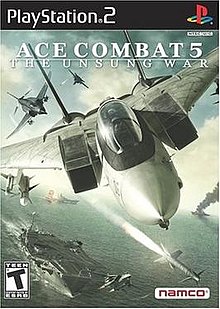
Ace Combat 5: The Unsung War (released with the much more inferior subtitle of “Squadron Leader” in PAL regions) is an arcade flight combat simulator developed by the Project Aces division of Namco. After making a huge splash in the PS2’s release year with Shattered Skies in 2001; could the team replicate such success three years later in 2004?
Having been a complete newcomer to this series back in August it still surprises me how much love and praise I have for this franchise, even when there are some rough edges in this particular entry.
On a distant continent, in a faraway land
Starting on the Osean continent in the year 2010, The Unsung War starts solemnly by recapping the events of a war fifteen years ago. During a conflict known as the “Belkan War”, the eponymous Belkans set off seven nuclear detonations on their soil, killing thousands and shocking the world into a ceasefire and eventual peace treaty.
After this, players are directly thrown into the action with a cutscene depicting a sudden encounter and the rookie “nugget” pilots of Sand Island Base needing to engage numerous unidentified bogies. Out of everyone who took off; only the flight instructor, Captain “Heartbreak One” Bartlett , and three nuggets, Blaze (mute, faceless player character), Kei “Edge” Nagase, and Alvin “Chopper” H. Davenport returned alive.
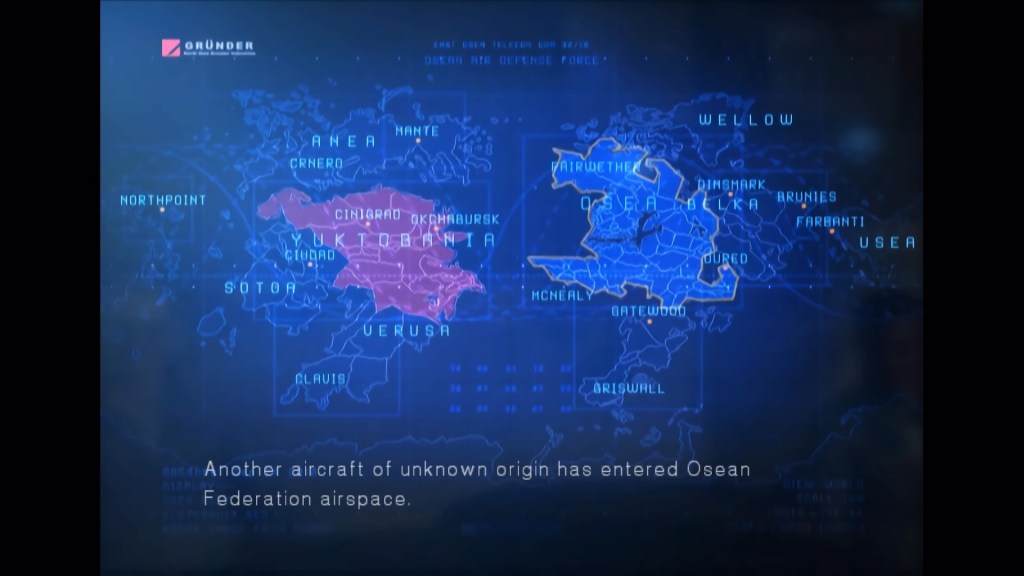
Routine operations resume after this incident. All remaining pilots are assigned to the Wardog Squadron and undertake straightforward missions, such as trying to escort a spy plane to a landing and destroying reconnaissance drones. During each mission though, Wardog is engaged by more unidentified bogies, the only hint to their origin being an airbase across the sea, in the country of Yuktobania.
These are not harmless incidents though, because as soon as Wardog completes only their second sortie Yuktobania declares war on Osea, beginning a lightning offensive.
Key themes to the plot in The Unsung War are mistrust and how rapidly the tide of battle can turn. Whereas the previous entry would frequently present scenarios where victory seems incredibly distant; this game prefers to drip-feed victories before violently taking it away and resetting any meaningful progress.
Mistrust develops from these incidents as both Wardog and players suddenly become unsure of who to trust. From the mysterious 8492nd Squadron, ghosts in the wind around major incidents, to the base commander and other military personnel around Sand Island. Throughout the entire progression of the war, doubts start to manifest, even to the point of wondering why this war began and who is perpetuating it.
A motormouth, an action girl, and a hopeful mechanic
The key characters players will be spending time with throughout the game are their three wingmen. Whilst they serve a gameplay purpose which will be elaborated on later; their characters and personalities are more fleshed out than in Ace Combat 4.
Instead of cut-and-paste mission dialogue talking about how one of them is going to earn their ace wings today, or telling you about their radio failure over their radio, each wingman has their own distinct personality that will come across during missions and between-mission cutscenes.
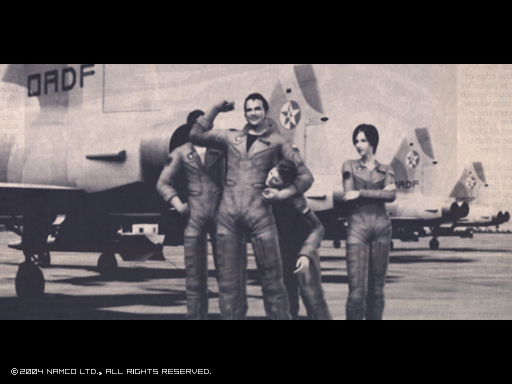
Chopper is notorious for being a non-stop chatterbox, to the point different commanding officers and AWACS Thunderhead have often asked him to kindly shut up. He even chose his callsign based on having a tendency of “shooting his mouth off” over comms.
Using this gift of speech; he is the loudest anti-war voice of the squadron. Whilst he follows through with the mission, Chopper often questions the nature of war, specifically when following orders would endanger the lives of soldiers and other pilots.
Nagase offers a similar perspective, but she does so in a more restrained way. Whilst Chopper strikes hard into the issue of modern warfare; Nagase simply wishes to enjoy the feeling of flying with equally skilled pilots, lamenting what it would have been like to fly alongside enemy pilots during peacetime.
This wish extends to other parts of her personality. She lodges her objections to the Arkbird, a large white spacefaring vessel initially designed for removing Ulysses asteroid fragments from orbit, being used for wartime purposes instead. These feelings can almost amount to disillusionment as she interrogates the Osean president on why the “beautiful white bird” had to be used for war.
Finally, comes Hans “Archer” Grimm, the replacement as your fourth wingman once Captain Bartlett is no longer in the picture. When he joins, Grimm is not even a fully trained pilot yet, simply a mechanic wishing to stop the destruction of their home base and quickly making up for his lack of formal training in the skies.
Whilst he shares the anti-war opinions of the other wingmen; it is presented in a more subtle way. Grimm instead is shown as an almost ideal soldier, they will follow their orders if legal, and they will want to minimise casualties on both sides in doing so. This detail is expanded upon further through mid-mission radio chatter where Grimm reveals he has a brother on the ground, perhaps worrying about the possibility of never seeing him again.
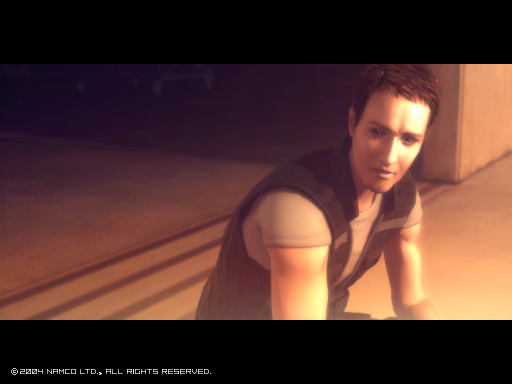
To cap off characters, talking about the narrator seems like a good idea. As opposed to being a nameless child in an occupied town, the game offers us Albert Genette, a young freelance journalist/photographer. (Fun fact: Genette is one of the first credited roles for all-round badass Matt Mercer.)
Genette fulfils the role of an outside witness to the game’s events, taking photographs of key moments throughout the story, and acting as the catalyst for the reputation of the main characters through his piece “The Four Wings of Sand Island”, written after one of the major opening events of the war.
Planes! You want them, we got 53 of them this time!
Yes, that’s right. Ace Combat 5 has 53 unlockable planes for players. This is a massive upgrade when compared to the total in the previous entry being 21. However, with this many planes there is almost certainly going to be a catch, and in this case it is the progression system being woefully unsatisfying in areas.
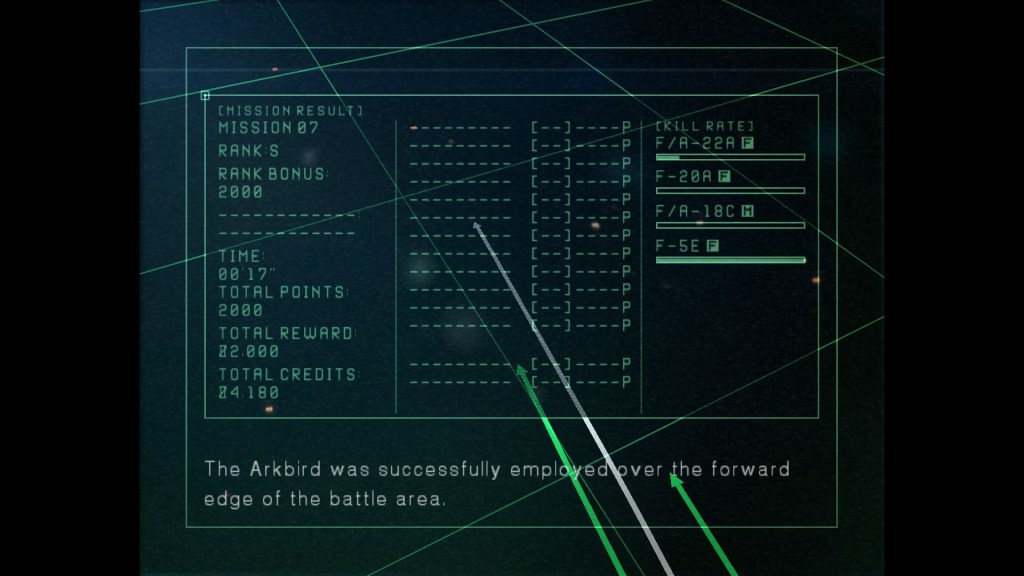
Whilst the system is still in place for players to unlock new planes after specific missions; certain planes now carry a varying number of “branches” leading off from the base plane you can buy, said base plane having an empty gauge beneath it. This gauge is the “kill rate” of that plane and fills up with kills and minigame completion. When full, the next plane on the branch is unlocked.
In theory, this system is a good idea. Rewarding players with better tech for just using the planes in missions is a great boon to replayability, but in the end it comes off as feeling grindy and unfulfilling.

Throughout my initial playthrough I found it incredibly difficult to reliably commit to filling up the kill gauge on most planes. Usually because as I came close to unlocking the next branch on one; a better aircraft would have already unlocked and it becomes more worthwhile to invest in that rather than stick to what was already in use.
This feeling of grinding is amplified by what is, in my opinion, the worst part of Ace Combat 5: there are no special weapon options on the planes.
When considering buying a plane, players not only have to take into account the statistics of that plane; they also need to wonder if they will get good usage out of its singular special weapon. This can provide some interesting decisions when deciding wingmen loadout but ultimately it restricts the potential of some amazing in-game planes.
Much like a WSO, gameplay is taking the back seat
In a prime example of quantity over quality, Ace Combat 5 has the most missions out of the PS2 trilogy, but a lot of these missions are bland, unsatisfying, and in some cases poorly designed.
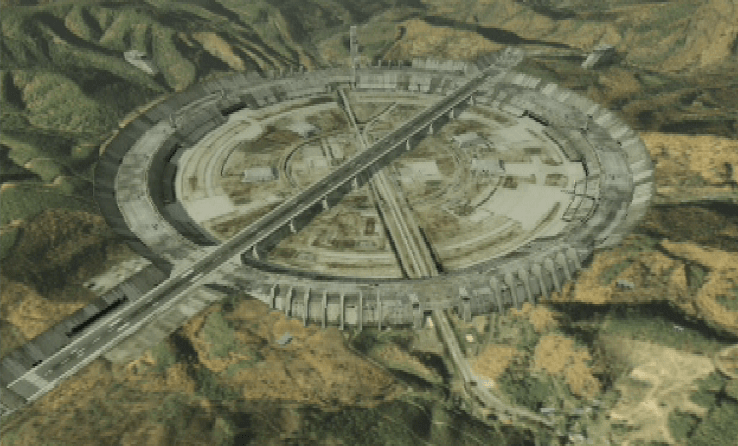
The majority of missions carry very little gameplay weight, ultimately becoming formulaic in the worst possible way. Complex missions from the previous game have been traded in for focusing more on wingmen character development mid-mission, supplying intermittently entertaining dialogue at the cost of feeling engaged with the task at hand.
Instead of leaving players exclaiming, “oh my god! What could happen next?”; quite often they will find themselves asking aloud, “is anything going to happen, or is this it?”.
When a mission is done well, the impact it leaves is noticeable. A handful of ground attack missions (12A and 26 of particular note) stand out beautifully as both intense and being the perfect length, whilst full-scale dogfight missions (17 and 18+) make their mark despite the dogfighting in this game leaving players wanting.
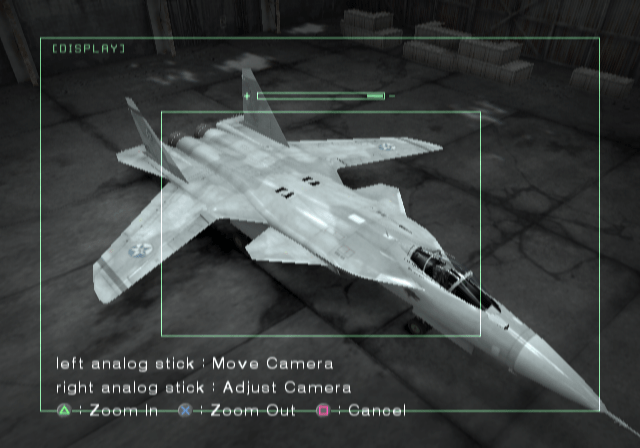
It is honestly a damn shame that the AI in this game can lead to aerial battles feeling sedentary. Unless you specifically lead them on enemy planes will rarely try to get behind players, and when they do acquire a radar lock there is a very high chance that they will just not fire a missile, allowing plenty of time to manoeuvre behind them and quickly pop them with two/three missiles.
That last bit is of note, as some enemy planes are more resilient than others. Now, this makes sense on some attackers/bombers that can be encountered throughout the game… but there is honestly very little reason why Tornados and MiG-31s should have more resilience than Su-47s. The rival ace squadron, in advanced Russian fighter jets, are easier to shoot down than a small European multirole developed in the 70s. This should not be possible.
One of the main selling points for Ace Combat 5 is the wingman command system. Using the D-Pad players are able to issue three tactical orders, and decide whether special weapons are free or safe. The tactical orders are:
- Cover. The default order that players start the mission on. Wingmen will stay close to the lead plane and attempt to shoot down anything that attempts to tail them.
- Attack. Useful for missions involving large resilient targets or clusters of escaping fighters. Wingmen will target whatever the lead plane is currently looking at.
- Disperse. My personal most-used command. Wingmen will spread out from the lead plane and attack targets on their own volition.
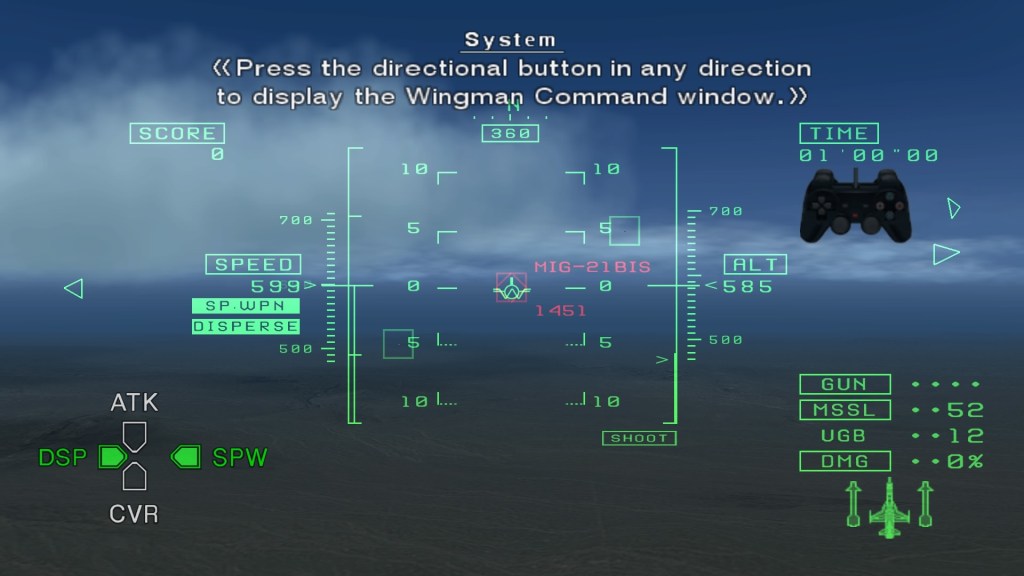
Wingman commands are somewhat divisive within the Ace Combat community, and players are split whether they are a gimmick serving no gameplay purpose, or that they add a layer of tactical depth to missions. Personally, despite defaulting to the disperse command, I find myself in agreement with the latter category, enjoying having to make decisions on the fly whether to adjust my command or not.
The D-Pad is also used to answer yes/no questions posed by the wingmen and other NPCs. For the most part these have no impact on gameplay and are mainly used to further build characters throughout missions, though in some cases answering a question about splitting up or focusing firepower will result in wingman tactics automatically changing.
There is also a case where answering yes or no will change what mission is tackled next, and there is no indication this is going to be the case and is honestly a bit stupid.
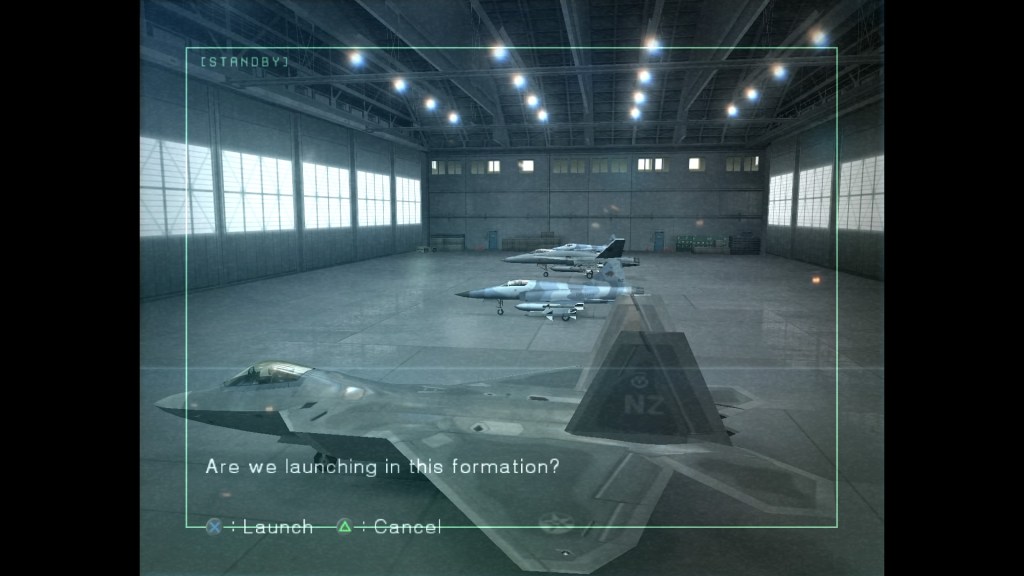
Before each mission players are able to choose both their plane, and what planes their wingmen will be flying in. A box in the bottom right will inform whether or not the formation is suitable for both the air enemies and ground enemies expected to appear, and a wingman will comment if a formation is not up to snuff.
This is genuinely quite a fun system, as it allows players to determine how they want to play the game and use wingmen loadouts to help cover whatever weaker areas may remain. Want to fly escort for a flight of attackers? You can do that. Fly in a badass formation of jet black Rafales? Go right ahead. Make your wingmen defend you as you use a Warthog for everything? It is your God-given right to do so.
Under pressure (sensitive controls)
So… bit of a confession to preface this segment, when I initially played Ace Combat 4, I actually did it with a Dualshock 1 controller, as opposed to a Dualshock 2. This means my control analysis of the game was a little bit off due to how the pressure sensitivity works on the DS2. I hope to rectify this now.
The pressure sensitive controls for the bumpers do work to bring a level of realism to the game. Lightly holding down L1 will slow the plane gently without deploying the airbrake whilst a firm press down will enable rapid deceleration with said airbrake, and acceleration can be precisely controlled from gradual acceleration to full afterburners.
(NB: the following points are made from personal experiences/controller handling issues)
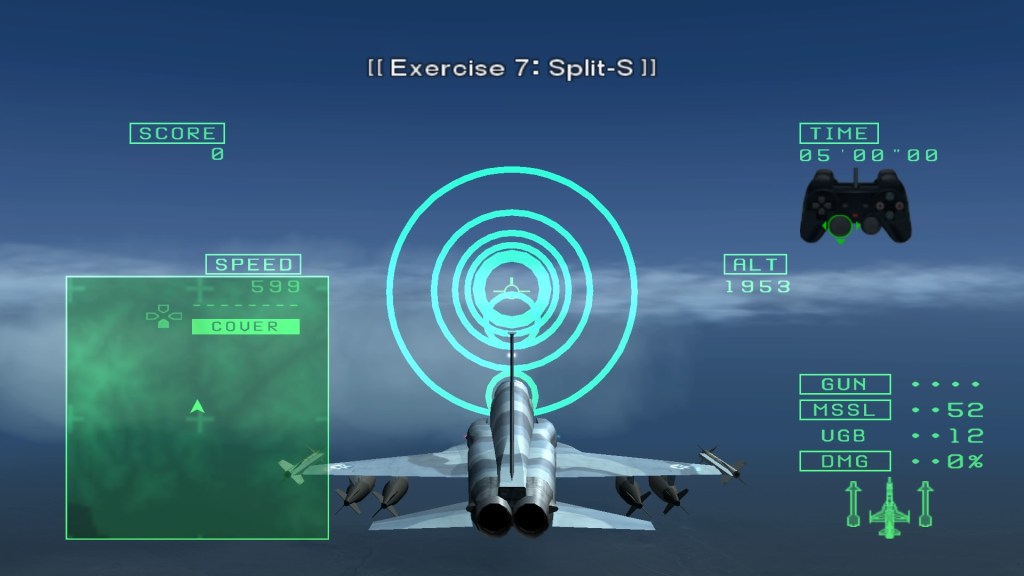
However, I do wish there was an option to turn this setting off. Quite often I found myself holding the controller in an awkward way to enable flying at full speed with afterburners consistently, leading to mild-to-moderate hand pain. This is not helped by a history of grip issues with controllers, and whilst the DS designs are fairly ergonomic; it is a struggle to balance comfort against efficient gameplay.
Similar issues were found with how extending the radar range worked. The level of pressure on the Square button would determine how far the radar would show, and unfortunately for me I really struggled to get a hold of this system. I would never know if I was applying too much pressure on the controller itself whilst trying to get the radar open, often leading to quick presses to determine where to hit next.
These issues are resolved for me in the digital remaster for the PS4. The superior trigger design of the DS4 controller along with the controls no longer being pressure-sensitive provide an overall better gameplay experience.
(personal experiences points end)
Outside of these issues though, everything else is absolutely spot on. Analogue stick movements control the plane to the letter of the player’s intention, swapping between regular missiles and special weapons is extremely responsive, and changing between third-person, first-person, and cockpit view is handled simply through a quick click of R3.
One minor change that feels a bit illogical is the removal of the satisfying plink plink plink sound that played whenever machine guns were used against enemy planes in AC4. It provided audible feedback that shots were actually hitting the plane players were firing at, but instead this game handles it with standard “Hit” indicators which struggle to consistently indicate if the guns are finding their mark.
The man who can never retire
A major new addition in this game is “Arcade Mode”, a short series of levels with limited ammo, fast-paced objectives, and a choice of progression paths for an easier or harder time. The average playthrough time will be about thirty minutes depending on how many restarts are needed on later missions.

There is also only one plane available for this mode; the F-22 Raptor. This is because players are once again assuming the role of the legendary ace from the previous game, Mobius 1, and nothing else would suffice.
The story is brief, those Young Erusean Officers(TM) have refused to acknowledge the surrender to the Independent State Allied Forces (ISAF) and have reformed under the banner of “Free Erusea”. And the task is for Mobius 1 to go in alone to diffuse this risk to peace.
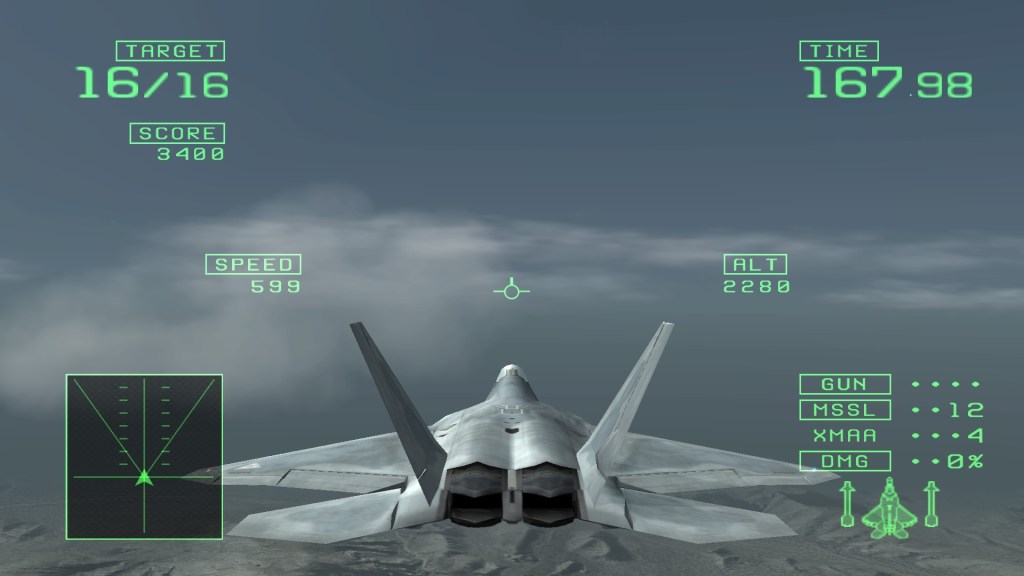
Yes, alone. Because as the briefing officer says, analysis has proven that Mobius 1, with the assistance of AWACS Sky Eye, has the same operating strength as an entire ISAF squadron. And the high-octane action of this mode definitely proves that.
Whilst the problems with dogfighting will lead to some missions feeling a bit unsatisfying; it almost feels appropriate here. Cleaving through targets with ease fits the legend of the Ribbon Fighter, especially in the first mission where upon seeing Mobius 1 you can see fighters turning around on the radar to run away from him.
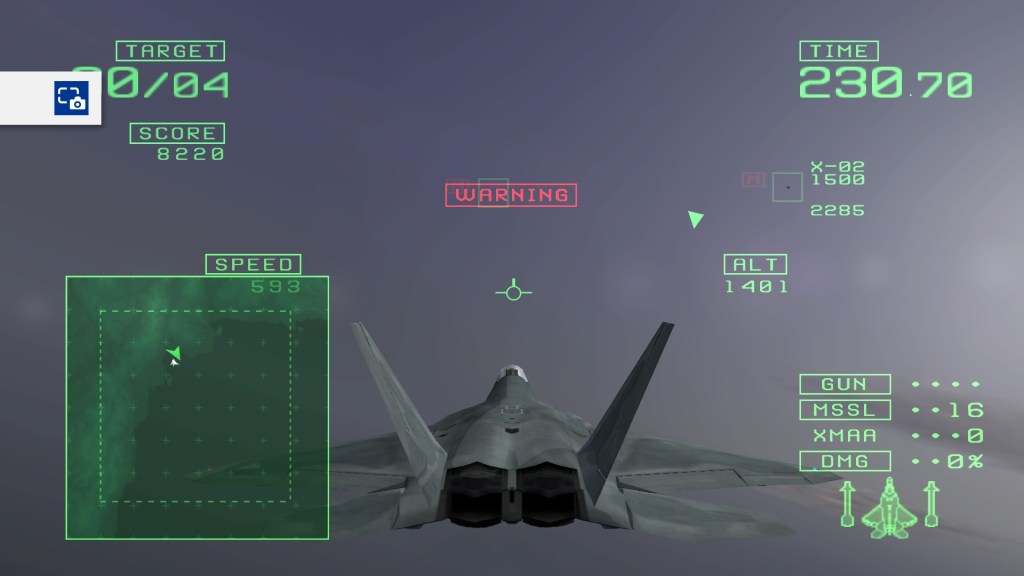
The mini-campaign culminates the same way regardless of which route is chosen by players. Assault the port facility Free Erusea are operating out of, after which Mobius 1 is ambushed by unmanned X-02 fighters, the superplane from the previous game. Is it disappointing to have such a dogfight be in this game’s mechanics? Yes. Is it nonetheless fun and cathartic? Also yes.
It also serves a purpose to the campaign mode as finishing an Arcade run will unlock the F-22 for purchase as early as Mission 5, a whole twelve missions before it should unlock, along with making the ISAF livery available for New Game+.
Use this knowledge, and power, with discretion.
A sweeping score for an unsung war
This should come as no surprise. Ace Combat 5 has a fantastic soundtrack, and whilst the quality of missions vary; the music backing them up remains absolutely beautiful and in contention for being the best soundtrack of the PS2 trilogy.
(Again, my thanks to Zaptroxix for making these extended OST videos. You are doing valuable work every day.)
Rendezvous falls into the category of “early game Ace Combat mission with music greater than it has any right to be”, think Blockade in AC4. The track starts off tense, with fast-paced strings playing with brass sounding off every so often, giving the impression that despite the mission starting off at the “end” of an operation; something is about to go down.
Percussion kicks in as the strings increase in intensity, all building towards a crescendo for the chorus to present itself as a perfect accompaniment to an early game furball against enemy fighters and bombers looking to destroy the carriers you were tasked to protect.
Tetsukazu Nakanishi, I bow to your ability to make sonar pings fit perfectly within a song.
Both Scinfaxi and Hrimfaxi (the superweapon subs in the game) share leitmotifs and composition structure in their themes, so why does Hrimfaxi win out here?
Scinfaxi projects an aura of unease, unsure as to what the true capabilities of the sub might be. It starts out slow, with string scales and the aforementioned sonar pings before transitioning into a brass section that will fade in and out as the song progresses, everything soon cutting out as all that remains are synths and sonar, anticipating what the sub may do next.
Hrimfaxi throws all pretence and preamble aside, instead choosing to open with the signature sonar ping before launching into a distorted electric guitar with the string scales taking a back seat. Whereas Scinfaxi wanted to create tension; Hrimfaxi is creating despair. Wardog are not enjoying the same tactical support they had in the last encounter, and if Hrimfaxi cannot support the Yuke frontline they will do everything in their power to go down fighting.
Admittedly though, this guitar is also probably in contention with the solo from Comona (AC4) in how hard it goes throughout the song. It very rarely breaks off aside from the shared synth and sonar section from Scinfaxi, acting as amazing boss battle music as planes strafe the large sub.
Spoilers in the next section
The war is over. With the threat of nuclear annihilation abated, the Ghosts of Razgriz can finally rest.
Or they would, if the orbital cannon carrying said nuke was not on a collision course with the Osean capital city of Oured.
As their final sortie, the heroes take off from city highways to fly out towards the SOLG. Dispatching elite Belkan air force aces on the way and eventually reaching the massive structure as it descends to a vulnerable altitude. And then the music kicks in.
The Unsung War conveys multiple emotions. Sadness that no one will know the true story of the Ghosts until they have long since faded from memory, a sense of duty in carrying out this one last mission despite the struggles faced previously, triumph knowing a new dawn will come as they end this war for good on New Year’s Eve.
The way the song progresses reflects how a player might be feeling throughout this mission. Four pilots, officially listed as killed in action weeks ago, take on a task they can never be recognised for. A single male voice comes in, singing the legend of the Razgriz, reflecting how alone these pilots may be in their task.
But before long, a female voice joins in, and over time there are more voices added to the choir with the singing growing in intensity. The Ghosts are not alone. Everyone who has looked up to the sky and saw the black shadows zooming by are with them. They cannot be there in person, but they can add their spirit to wish them victory.
“After a period of slumber, Razgriz returns. This time, a hero.”
My only criticism? It does not have a fitting mission to go alongside it. Destroying the SOLG is impactful, but it has the structural integrity of a toilet paper loincloth and after the Belkan fighters are eliminated; there are no threats to players aside from accidentally flying into the SOLG.
…and despite my tendency to fly into slow moving objects in this game I somehow managed not to do that.
Debriefing
Ace Combat 5: The Unsung War is an amazing game and a worthy entry into the Ace Combat franchise. Whilst unnecessary mechanics and potential control issues do have some impact on the core game itself; there is still infinite replayability to be had and hours of fun awaiting players. It is definitely the weakest entry in the PS2 holy trinity by a wide margin, but when it hits its stride there is the signature Project Aces love and dedication to their craft.
If you have a PS2, it is usually quite easy to find a secondhand copy online or at trade-in shops. If you have a UK registered PSN account, buying a Digital Deluxe edition of Ace Combat 7: Skies Unknown will bag you a digital copy of AC5, which comes with enhanced resolution, better controls, and trophy support.
And believe me, when the time is right, I will be tackling the absolute beast that is Ace Combat 7. But before that, someone needs to go check if their buddy is still alive.
Personal note
Hey everyone. I’ve tried out some new techniques with this review. Rather than the usual “Plot, Gameplay, Controls” heading I’ve tried to make them a bit more entertaining and engaging whilst also relating to the content I wanted to discuss in various sections. I’ve also limited my usage of addressing the reader directly to try give this review a bit more objectivity and provide a more neutral sort of vibe.
If you have any feedback on how these things feel to you, I’d love to hear it, as coming up with different section headings was pretty fun.
And, again, I want to express thanks to my friend Clara. Without her I wouldn’t be playing Ace Combat today and would have missed out on so many amazing games. I appreciate you massively. (Follow her at @ClaraDotH on Twitter for progress on her own arcade flight game.)
 Rosalia Rambles
Leave a comment