Category: Card Games

  • Redundancy Review: Day 81 & 82, “Improvisin’, Helldivin’, and Survivin’”

    (for context on what this series is, please see my Day 1 post here: Redundancy Review: Day 1, “A New Beginning” – Rosalia’s Rambles)

    Good morning fixers and repairers, welcome to a double feature for Day 81 & 82 of Rosalia Rambles Redundancy Review.

    Did I miss a day out of my commitment for writing every day before my convention trip? Yes I did. Do I have a good reason for it? Yes I do.

    I have been enjoying myself and relaxing. I had a friend over for a roast dinner yesterday which took up a lot of my energy in terms of preparation and then I played a lot of Helldivers 2 to continue unlocking stuff from the Halo warbond.

    That said, I did make a marginal improvement to Rambles as a whole by upgrading the top navigation bar: adding in a dedicated Redundancy Review button to navigate to all of these articles, and adding in both my fiction & commissions right at the top bar to advertise that part of the website.

    Taking several factors into consideration, the primary factor of which is my rent going up by £40 at the start of October, I definitely want to put more effort into advertising the fact I am available for writing commissions or quality assurance contracts. Part of me realises that returning to the stable corporate structure might not be in my foreseeable future, and as much as the freelance life unsettles me a little bit; there are a fair few benefits that come with it as well.

    Specifically, freelancing gives me a higher chance of remaining remote in my work lifestyle, which I would very much like to do for the foreseeable, both for personal preference and to help try to maintain the idea of remote work becoming the norm in the coming years.

    For those who might not be aware, I consider myself a “remote work advocate”, to put it in LinkedIn speech. I believe remote work is the ideal way for people to work and whilst there are definitely going to be a fair few exceptions within that statement, I feel remote work needs to be more widely adopted across different industries – especially in the increasingly volatile tech industry.

    I see a lot of techbros talk against remote work, saying that nothing beats the in-person energy of experimentation and bouncing ideas off of each other… and to some extent, I agree.

    Brainstorming ideas in-person can lead to more off-the-cuff suggestions, but I feel it should skew more towards regular team days that focus on both work and relaxation. Gather people together for meetings where they can discuss how things have gone in recent months, where improvements can be made, and then follow it up with an evening of relaxation together, either going out for a meal or engaging in an activity.

    Remote work leads to healthier people and higher productivity. At least in my case, the fact I am working in my own space without the distraction of people talking to me or coming by my desk for a chat leads to me getting my work done a lot quicker, especially when taking into consideration that one of my (many) neuroses is that I really struggle to work when I am aware of someone looking over my shoulder or perceiving my work in any way.

    I am working, you do not need to stand over my shoulder and assure yourself that I am doing so. It will get done, so leave me alone and let me work…

    …god help me if I end up getting an in-person role in the future, in my now almost five-year career as a QA I have worked a grand total of seven days in an in-person setting, and of those seven days only three of them could be classed as actually doing my job since one of them was getting to the office for the first time and being toured round with the remaining three being in-person meetings where I spent more time commuting than I actually did contributing.

    It would be one hell of a socialisation experiment, but ultimately, even if I am not the most social person at work, I still get the job done.

    Want to hire me and watch me prove that? Get in touch! Quality assurance, fiction writing, technical writing? I will do it all and am more than happy to work within your budget to find a solution that benefits both of us.

    Time to head into the review, and considering a well-known card game accessory manufacturer is currently going through a lot of bad publicity due to stupid decisions regarding AI usage and Harry Potter licensing deals, I think it will be good to review a deck box from what is quickly becoming my favourite manufacturer.

    An aside, fuck you Ultimate Guard. Your Katana sleeves were actually some of the best on the market but I cannot in good conscious support you given the decisions you have made over the past weeks.

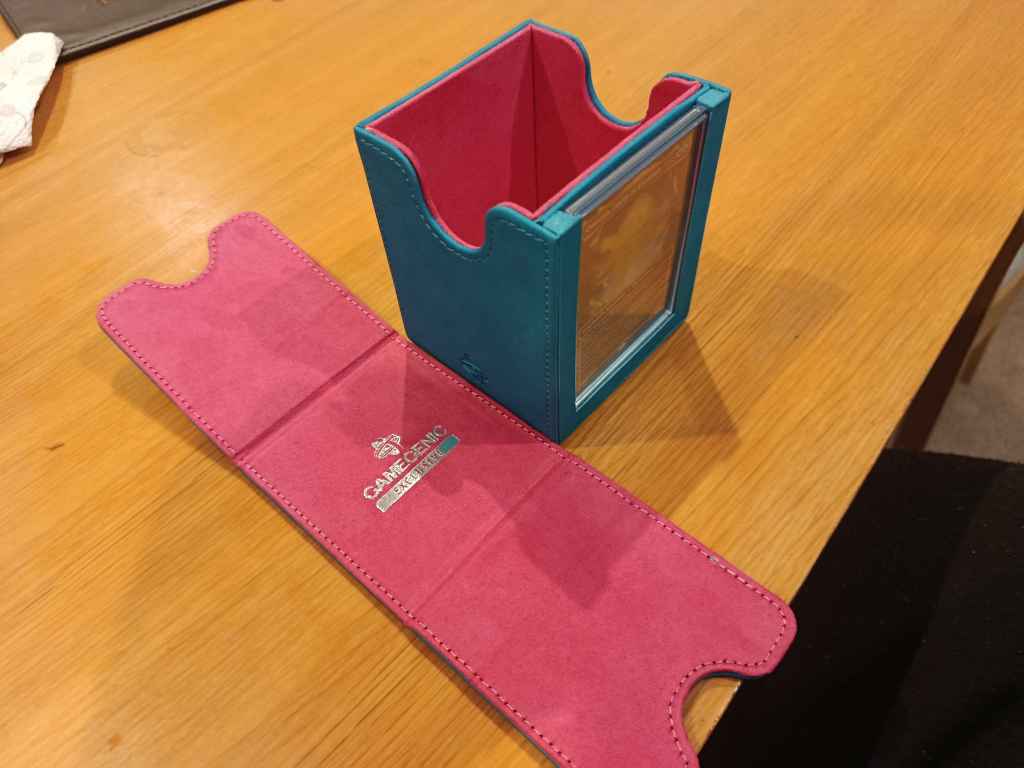
    Anyway, here is the Gamegenic Squire Plus 100+ XL Deck Box, in the Teal/Pink colour scheme because the trans vibes must be immaculate.
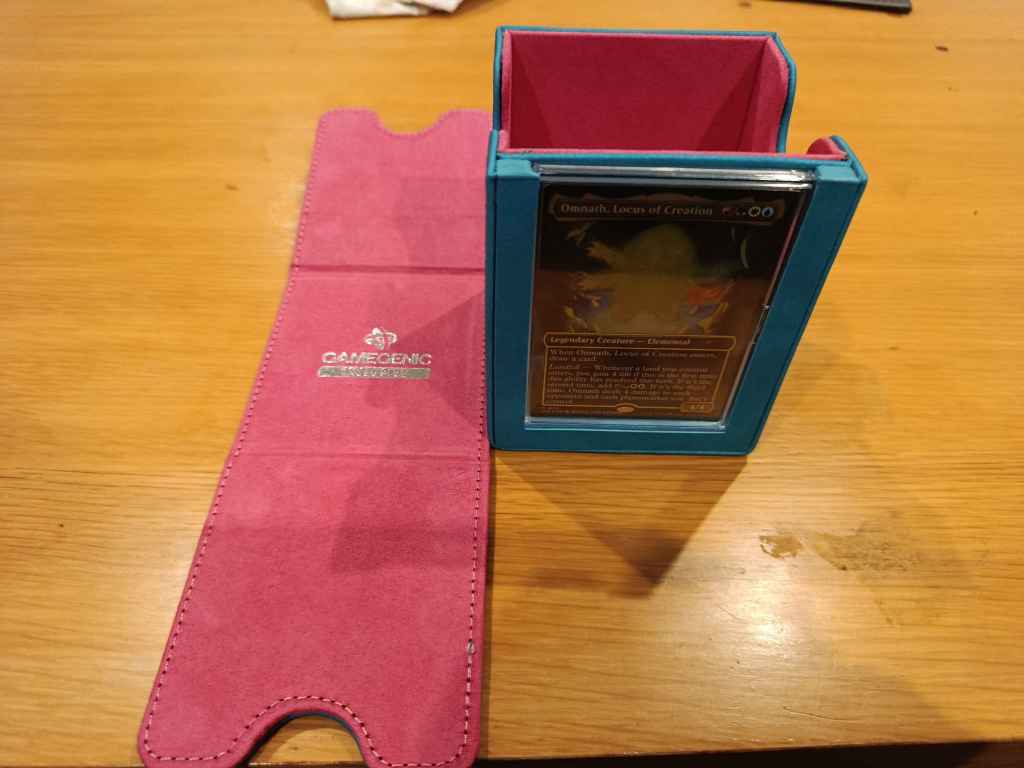
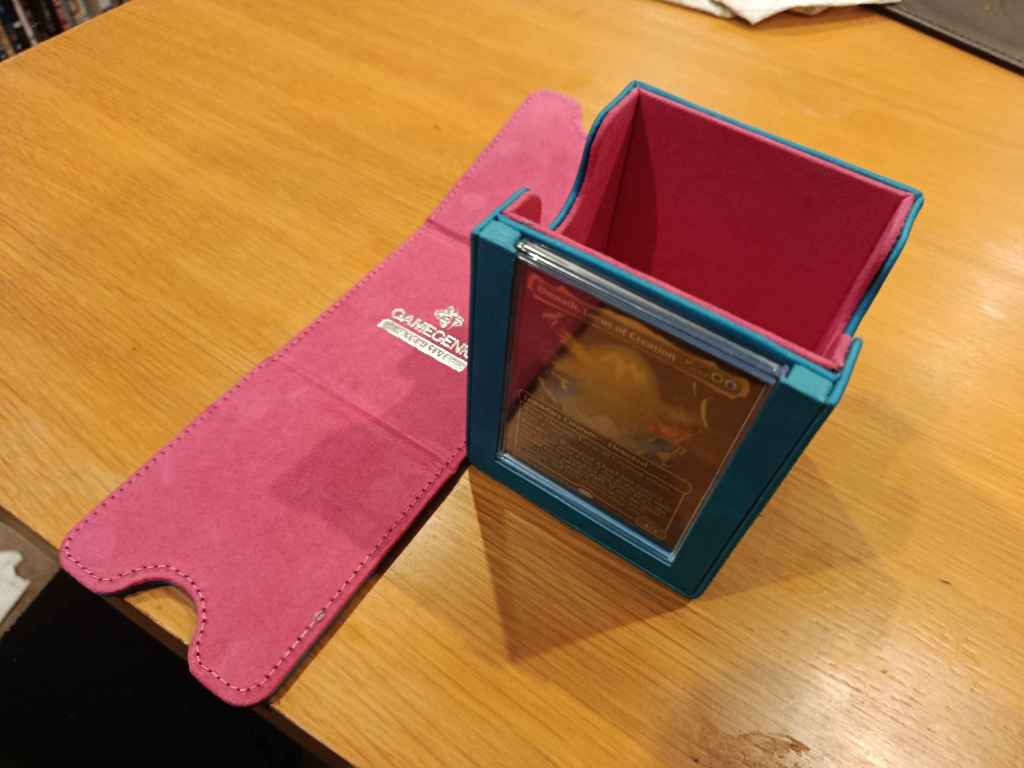
    I am not entirely sure when this particular deck box was released, but I definitely think it was at least in the last year or so, and if we go by how little stock of these exist within UK stores currently, it is reasonable to assume they are quite popular – a sentiment I fully understand now that I have my hands on one.

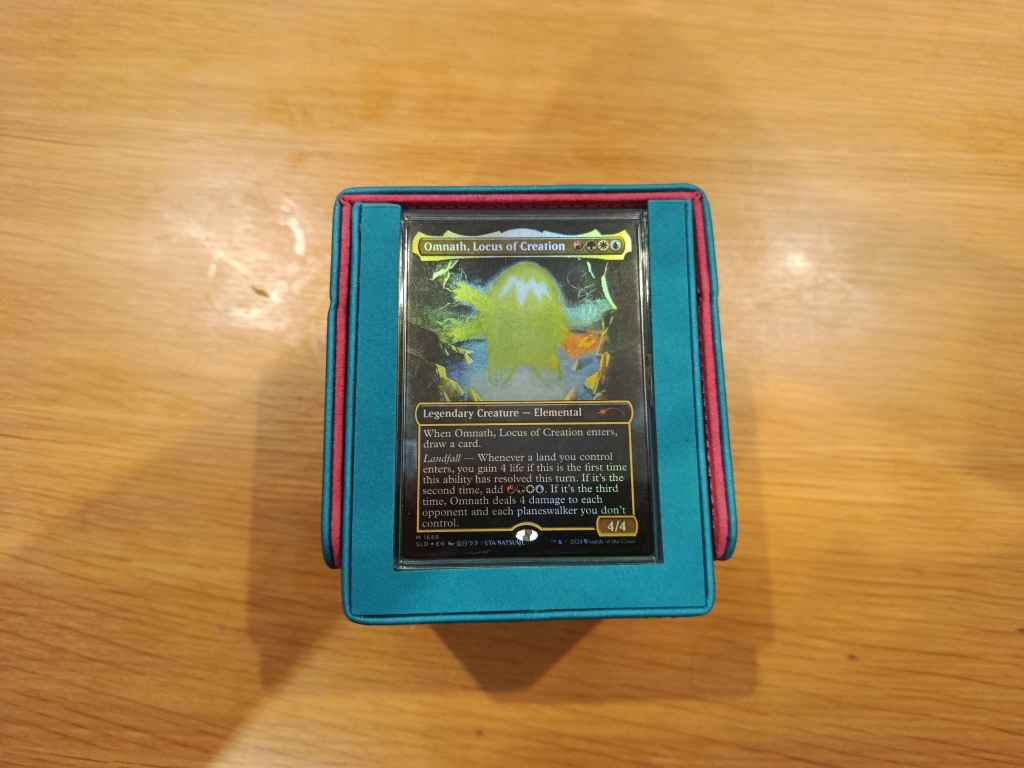
    The headline feature of the Squire Plus over the regular Squire is the addition of the transparent hard plastic card case that can store a single standard-sized trading card. This is specifically designed around the immensely popular Magic: the Gathering format “Commander”, which features a single card chosen to be your commander.

    It presents an extremely novel solution to the eternal problem that many Magic: the Gathering players face: remembering what deck is stored in what box. With your commander displayed prominently on the outside of the deck box, it not only allows for finding the deck easier but it also allows your decks to become display pieces themselves, proudly showing off your favourite creations on your shelf.

    Additionally, the magnets on the lid of the deck box are extremely discrete compared to other magnetic deck boxes I own, barely being visible on the box or the lid itself leading to a very slim look when all put together.

    The MSRP of these deck boxes is listed at $27.99, which converts to roughly £20.78 as of time of writing. I got this a little cheaper than that from chaoscards.co.uk (not sponsored, but a big fan) at £17.95, which I consider a more than worth it price point for the quality you get in exchange.

    Now to figure out which deck I want to put in this thing.

    That will do it for today, thank you for reading this double feature of the Redundancy Review. Wherever you are, I hope you have had a very good weekend with plenty of relaxation, and that the Monday blues do not get to you too much tomorrow.

    For more information on the Gamegenic Squire Plus, visit the product page here: SQUIRE PLUS 100+ XL CONVERTIBLE – Gamegenic
  • Redundancy Review: Day 63, “Let It All Out”

    (for context on what this series is, please see my Day 1 post here: Redundancy Review: Day 1, “A New Beginning” – Rosalia’s Rambles)

    Good morning sobbers and weepers, welcome to Day 63 of Rosalia Rambles Redundancy Review.

    Last night I had a good long cry, lasting about three-quarters of an hour, and it was really needed. For some reason (possibly estrogen-related), my emotions flared up and I found myself wanting to cry over seemingly nothing, the main trigger point that finally set it all off being a Youtube short of a cute guinea pig wheeking loudly – animal videos tend to set my emotions off regardless, but very rarely do they make me want to cry.

    And I just… let it all out. First time in a long while that I have had a good cry, and even though I am paying for it this morning, it was something I needed.

    Part of the reason is definitely lingering anxiety around the convention I am going to soon. It has been almost six years since my last convention experience and I am feeling exceptionally nervous about both putting myself out there, cosplaying properly for the first time in a good few years, and trying to make friends/be social within a community I have been a quiet participant in for many years.

    Additionally, despite the fact I feel I am starting to heal from my redundancy, there is still some lingering trauma from everything that went down that seemed to be gnawing at the back of my mind during my emotional moment.

    I keep telling myself that I am still here, despite everything I have gone through and continue to go through, holding on to my continued existence as a reminder that I am extremely lucky in a very unkind world. My brother once told me that I “had the confidence to sail into the storm, and you have what it takes to make it out of it” – he specifically said that in reference to the fact I came out as trans, but it is something that sticks with me all the same.

    It is hard to exist as a trans person in today’s world full stop, but there is a certain pain that comes from being a trans person in the UK, especially when a supposedly left-wing government got voted in on the promise of “do not be as shit as the Tories” have specifically shat on me and people like me harder than they ever did.

    But I will make an effort to still be here, and still be myself.

    I will not be erased.

    I will not be silent.

    Death before detransition.

    I still have stories to tell, and even if it is taking a long-ass time to tell them, they will be told. Both for myself, and for whoever needs them.

    Feels kind of weird to pivot from such an absolute statement into the positivity of Hololive Tuesday, but… Happy Hololive Tuesday everyone! I am extremely excited for today’s review as it combines my love of VTubers and my love of card games as I review the Tokino Sora and AZKi Starter Deck for the Official Hololive Card Game English release.

    I bought two starter decks, one from TokyoToys in Glasgow when I visited, and another from The Gamers’ Emporium in Swansea on delivery, the latter of which was nice enough to send me a tournament promo pack as part of my order, thanks for that!

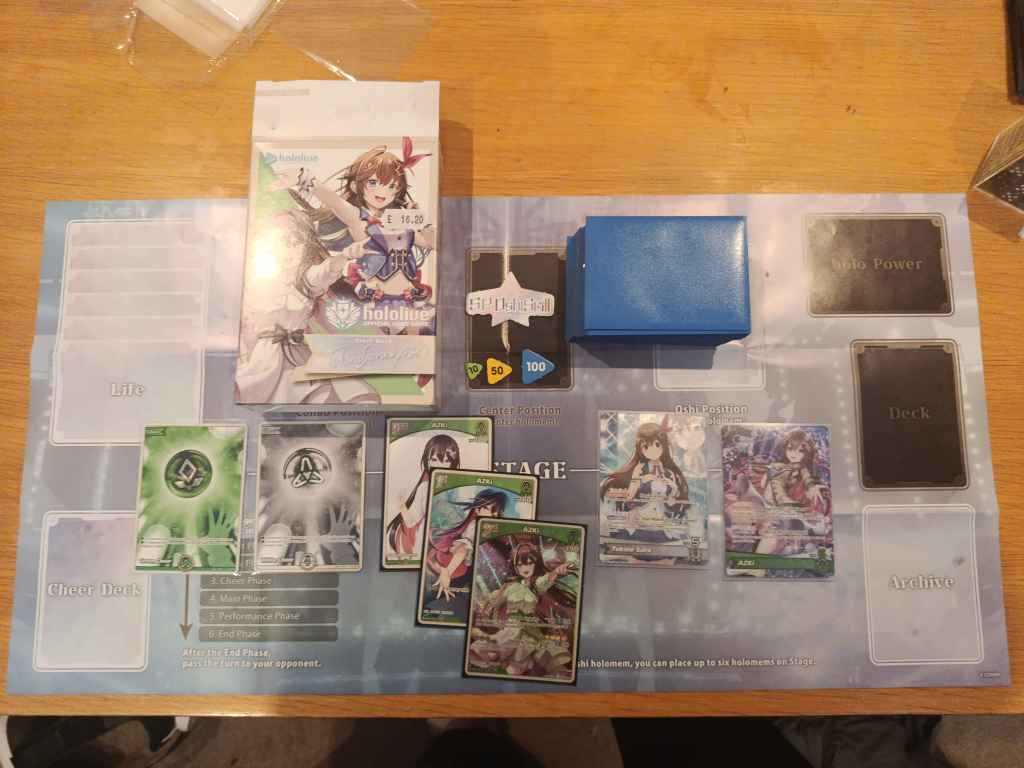
    I have laid out the majority of the contents on the included paper playmat, but to give a rundown, here is everything that is included in the box:

    • Two “oshi Holomem” cards in the form of Tokino Sora and AZKi
    • One 50-card preconstructed main deck
    • One 20-card preconstructed “cheer” deck, consisting of white and green cheers
    • 1 quick manual rules sheet
    • 1 paper playmat with marked zones for cards
    • 1 cardboard sheet containing a selection of damage counters and a “SP Oshi Skill” counter

    The box’s contents allow you to take everything out and play right away, with a surprisingly smooth first time play experience when following the included quick manual. 

    When my partner and I did a starting game both using the product we only had to clarify one rule using a Youtube video, after which the flow of the game became rather clear to us – though this comes with a small disclaimer that I have been playing card games regularly for around a decade now, meaning I can adapt to new games easier than most.

    For a brief explainer of how the game works:

    • You have your “oshi Holomem” who acts as the face of the deck, determining your health and carrying two special abilities: one you can use once each turn, and one that can be used once per game
    • You have a deck made up of “Debut”, “1st”, “2nd”, and “Spot” holomems along with support cards.
    • “Debut” holomems act like Basic Pokemon from the Pokemon TCG, being able to be placed directly on your “stage”, or bench to further borrow Pokemon terminology
    • Whilst on your bench, you can place down “1st” or “2nd” holomems to “bloom”/evolve your holomems into more powerful cards
    • “Cheers” act similarly to energy in Pokemon, being attached to your holomems as part of a “cheer phase” and being used to activate “Arts”/moves
    • You have a “center position” holomem who stays on the field until destroyed or swapped out, and a “collab position” holomem who stays on the field for a turn before returning to the bench to “rest”
    • The game ends when a player’s life is reduced to zero, when a player has no holomems on their stage, or if they cannot draw a card from their deck due to it being empty

    A lot of standard TCG rules and terminology, but given a Hololive flavour. I often describe it as Magic: the Gathering Commander format crossed over with Pokemon, which is possibly why I enjoyed it so much. The game definitely takes some amount of time to play through one round, which is why the current official tournament format is only Best-of-1.

    The card quality is fantastic, feeling solidly constructed especially compared to how modern Magic cards currently feel, with the included oshi holomem cards having texture applied to their foils, a common technique in most card games but a very pleasant inclusion for a starter product.

    I also have to admit that whilst I own significantly superior playmats that I will likely be using in future; I definitely have a soft spot for the included paper playmat. It reminds me too much of the old paper playmat you would get in old Yu-Gi-Oh starter products and tickles a nostalgic part of my brain in a weird way.

    As mentioned, the quick manual was actually rather intuitive for doing a first game, my only issue coming in the form of the explanation of the cheer phase. In the manual it reads:

    “Turn the top card of the cheer deck face up, and send it to your holomem on stage.”

    This reads pretty simply, but it caused the issue for myself and my partner to only initially send cheers to our centre position holomem until we looked up a video to check another rule where the person’s explanation of the cheer phase made it clear a cheer can be set to any holomem on stage, front position or back position. 

    A very minor gripe that might not affect a majority of players, but I would prefer the wording to be something like:

    “Turn the top card of the cheer deck face up, and send it to any holomem on stage (front position or back position)”

    For a little bit of easier reading.

    However, I find myself already in love and simultaneously anticipating & dreading when the next couple of sets are localised, knowing full well I have yet another card game I am going to become obsessed with.

    Well, considering that the next in-universe Magic: the Gathering set isn’t until 2026 now, maybe that is not such a bad thing.

    The starter deck was well worth the money in both instances, and if my brief review has made you interested in playing it, I definitely recommend picking it up.

    Three pages and 1000+ words, oh yeah, I am thinking I might be back! Thank you for reading today’s card game edition of the Redundancy Review, please continue to stay cool and hydrated wherever you are along with not letting the world get you down too much.

    For more information on the Official Hololive Card Game, visit the website here: hololive OFFICIAL CARD GAME|hololive production

  • Redundancy Review: Day 32, “Siesta”

    Redundancy Review: Day 32, “Siesta”

    (for context on what this series is, please see my Day 1 post here: Redundancy Review: Day 1, “A New Beginning” – Rosalia’s Rambles)

    Good morning legends and planeswalkers, welcome to Day 32 of Rosalia Rambles Redundancy Review.

    Is it past morning in the UK? Yes.

    Am I still going to say good morning in each review? Yes.

    It is another day of peak temperatures in the UK, with the current heatwave expected to start tailing off tomorrow leading into cooler temperatures and hopefully some rain. Even just heading out for around an hour this morning was near unbearable due to the humidity retaining heat in the air and making it hard to move around, with me needing to douse myself in cold water shortly after returning home.

    After playing some games and doing some card sorting as the sun rises to the highest point in the sky I suddenly remembered I needed to write today, but surprisingly I feel a lot better writing the review later in the day than in my normal morning slot – plus it gives me a good excuse to sit still and just focus on a task that does not require much physical movement.

    My new contracting role officially starts on Monday, with me feeling… cautiously optimistic about it. One of the things that I am going to try do with this role is not taking things too personally when stressful situations are ongoing like I did with my last role, I am a contractor here to help but ultimately unless the position becomes permanent I do not want to feel much of a personal attachment to the work.

    That is something I do need to consider when it comes to looking for a full time role outside of the pipe dream of getting to do writing as my job every day, the desire to have passion for what I am working on. Whilst I can detach myself emotionally to some degree, I want to feel excited about what I am working on or what I am learning about, feeling enthusiasm for the skills I can develop.

    Regardless, not going to sneeze at an opportunity to build a safety runway further, especially as, outside of my convention trip in September, I have very few major birthdays and events coming up that I need to plan for/spend for, which means I can build a very good buffer of savings before Christmas hits and hopefully I can take a few unpaid days off as winter hits, ideally relaxing on my birthday.

    If you want to help me enable doing this day to day, consider hiring me/helping me out. Aside from when friends and family pay for meals, I fund every review topic myself, so commissioning some work or getting in touch to help provide funds for review topics would always help.

    And because my brain is actually functioning enough to write today, I do have a review topic!

    As part of my trip out today and as a portion of the greater organisation work I have been doing around my flat, I needed to get a new card binder. Sorting through almost eight years worth of Magic: the Gathering rares, mythics, and foils has led to my multicoloured binder specifically exceeding its capacity. Thankfully there is a very solid independent collectibles store in the main shopping centre in town who were more than happy to help me out.

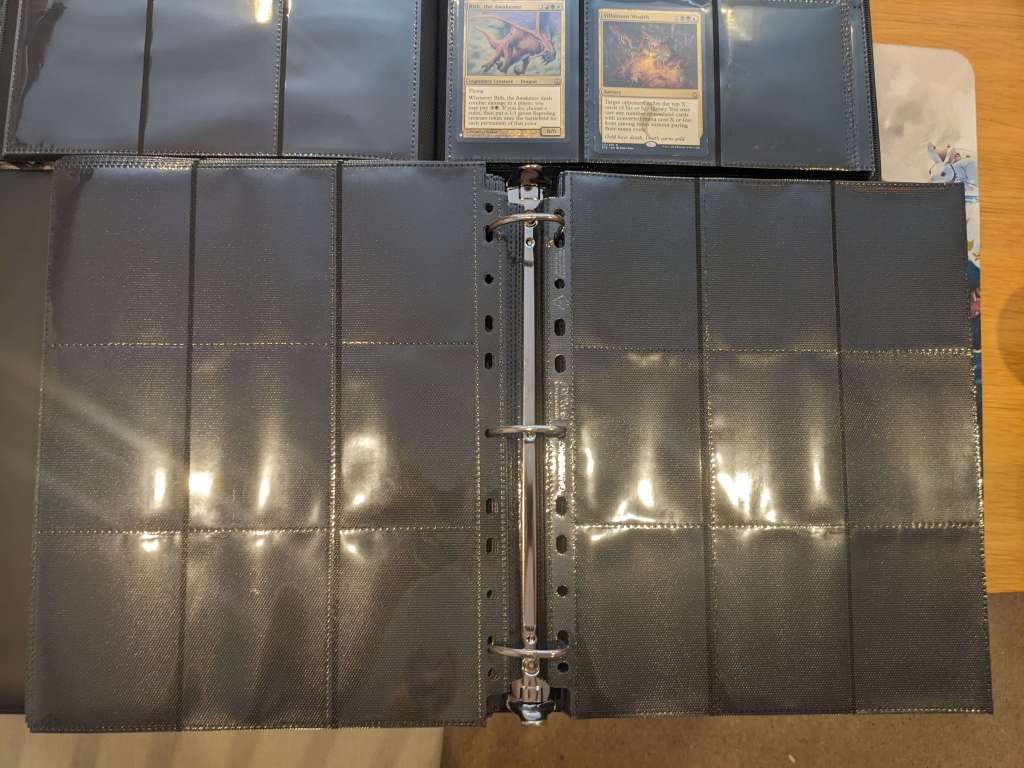
    So rather than buying a standard binder/card album, what caught my eye today was a pack of Gamegenic 18-pocket ring binder pages, with the box stating that its contents could hold 900 cards total, being more than enough for what I currently need whilst also giving me a fair bit of future-proofing.

    The pages feel high quality, and with them being sideloaded instead of toploaded it means the cards are more secure to being shaken around. One of my main worries when I was buying the pages was that it would not fit the binder I had picked out to go alongside it, but upon closer inspection the pages have a wide variety of holes along their margin, making it almost impossible to find incompatibility.

    Gamegenic are newer on the scene compared to card storage & protection giants such as UltraPro, Ultimate Guard, and Dragon Shield, but each time I end up buying a Gamegenic product I find myself pleasantly surprised at the quality of it. 

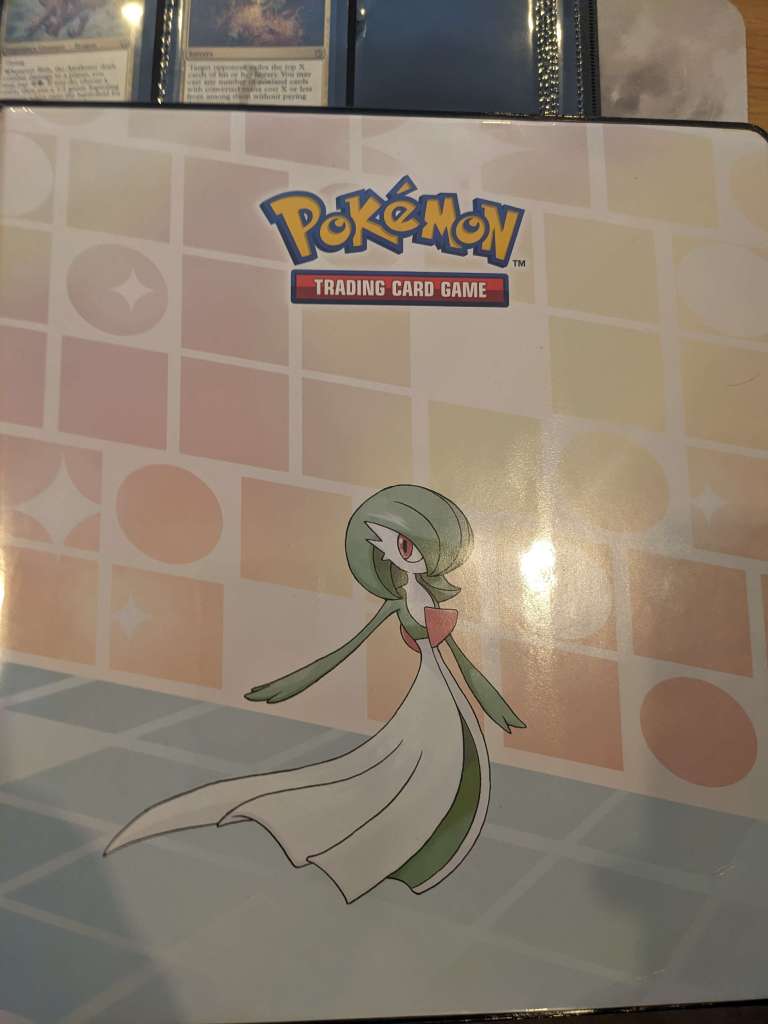
    That said, the actual ring binder I got today is an UltraPro product, and as this shop specialises more in Pokemon cards than in any other product, my options were limited to Pokemon-themed ones, but that is no issue.

    I managed to get a pretty neat one anyway.

    Thank you for reading the Redundancy Review today, please keep yourself hydrated in this warm weather and do not exert yourself too much when it comes to physical activity.

    For more information on Gamegenic products, visit their website here: Home – Gamegenic
  • Redundancy Review: Day 13, “Document Everything”

    Redundancy Review: Day 13, “Document Everything”

    (for context on what this series is, please see my Day 1 post here: https://rosaliarambles.wordpress.com/2025/06/11/redundancy-review-day-1-a-new-beginning/)

    Good morning crumpets and teacakes, welcome to Day 13 of Rosalia Rambles Redundancy Review.

    Main activity on the agenda today is a meeting with the Jobcentre to discuss the change in my circumstances, along with highlighting an error with how the administration company handled the payroll situation which has actively caused me to lose out on getting some money.

    Thankfully though, I have always been the kind of person to maintain an extremely robust source of documentation in any situation. Back when I was dealing with problems with the electricity company, and getting ready for a complaint to either them or the ombudsman, I went to Citizen’s Advice to get some guidance.

    The advisor said I had basically done their job for them, as they would be helping with gathering documentation and evidence. I walked in with a full month-long timeline of everything that had been happening, so all they really needed to do was give me the go ahead on what I was planning to do anyway.

    In a way as well, this series continues my habit. Every day I am creating something new that chronicles my journey through this next phase of my life, so there will always be a record of what I got up to, how I felt, and how the story unfolded.

    Beyond sorting out the situation with the Jobcentre and checking out job postings across the internet, it is mostly going to be having a day of connection with my partner. Over the weekend it was hard to do stuff together due to the heat getting to us and him experiencing PC issues, but with both of those things resolved now using his day off to spend time together seems like a good idea.

    I am still on the lookout for writing work though. The rhythm is now in full swing and each day makes me better at what I do. Food, games, music, all of them are in my repertoire fully now and I would love the opportunity to do paid work to explore my opinions on things.

    Today’s review will be a topic I considered briefly before ranting about Borderlands a few days back. One of my favourite Magic: the Gathering (MTG/Magic for short) cards, and how the deck around it took shape.

    Now, I know Magic is a very complicated card game. Being over thirty years old at this point in time and having a foundation of spaghetti code, it can be hard for outsiders to understand things – this is why I am going to write a short glossary on the terms to be discussed to hopefully minimise communication issues:

    • Colour – Magic has a system of five colours that determine what cards can do, similar to types in Pokemon. Colours do have a “philosophy” associated with them but that is a topic for another time
    • Commander – A format in Magic where you build a deck around a legendary creature (Commander), where all the cards need to stay in that colour identity, and you can only have one copy of each card
    • Spell – every nonland card in Magic is a spell, even creatures. The flavour of this is the players are dueling wizards, bringing forth powerful effectives each turn
    • Stack – similar to in programming, abilities in Magic work on a stack, operating on a “first in, last out” principle meaning whatever card is placed on the stack first resolves last

    Okay, preamble done, time to introduce the card.

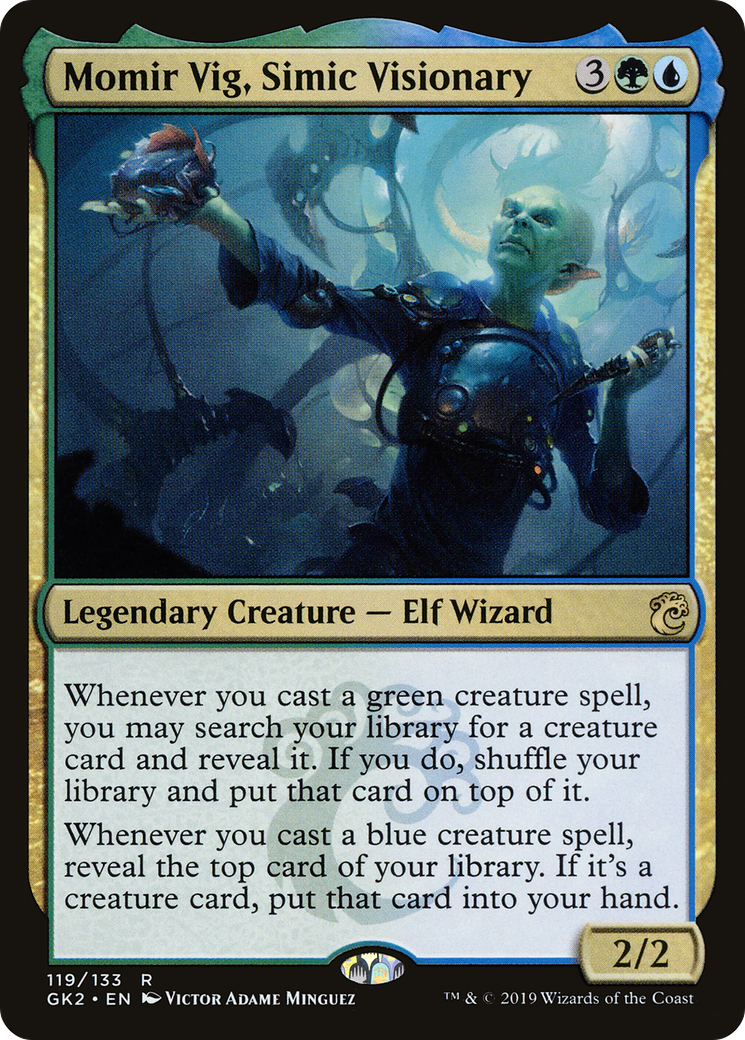
    Momir Vig, Simic Visionary is a blue-green card initially released in the 2006 set “Dissension”, part of the original Ravnica block, with the version above being released in the 2019 “Ravnica Allegiance” Guild Kit decks, which is where I got my hands on it.

    The ability triggers whenever a creature spell of the respective colour is cast. Green lets you grab a creature and put it on top of your deck, blue lets you reveal the top card of your deck – if it’s a creature, you can put it into your hand.

    Hopefully the combo is pretty obvious here: play a green creature to get a card on top, and then follow up with a blue creature to get it into your hand. 

    However, there is a little something in Momir’s rules clarification that makes this card very interesting.

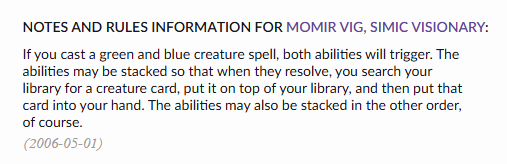
    If you play a creature that is both blue and green simultaneously, both abilities trigger. Due to how the stack works in Magic, the player triggering those abilities can choose to order them on the stack however they want. This means whenever a blue-green creature is cast, the player can essentially search their deck for any creature and put it into their hand.

    And if that creature is blue-green itself, then the process can continue ad nauseam… so obviously I built a deck around that entire concept.

    https://www.mtggoldfish.com/deck/6941266#paper

    Behold! Simic Slaw, named for the horrendous concoction made up for a LoadingReadyRun Friday Nights episode. It is a deck solely made up of blue-green creatures, but I went beyond that. Even though cards of other types have no synergy with Momir, every card (minus artifacts) is blue-green as well.

    Now, is this deck extremely fun? Yes. Is this deck very tiresome to run because of all the shuffling? Yes. Does this deck have a clear win condition? You bet your ass it… does not actually.

    Simic Slaw is one of my several meme decks built around a silly theme to have fun rather than anything else. I have decks I can bring out for being competitive or being scary at a gaming table, but the joy of Commander is making weird creations of cards that would have never got their time to shine otherwise- a gallery of cards from a specific colour pair definitely fits that vibe.

    Anyway, that was a page and a bit ramble around Magic, so I will end things off here.

    Thank you for reading the Redundancy Review today. Hopefully the Monday blues do not hit you too hard and you are able to relax at some point today. You are appreciated by both me and the world, so hang in there.

  • Redundancy Review: Day 11, “Hot two? Damn”

    (for context on what this series is, please see my Day 1 post here: https://rosaliarambles.wordpress.com/2025/06/11/redundancy-review-day-1-a-new-beginning/

    Good morning risers and shiners, welcome to Day 11 of Rosalia Rambles Redundancy Review.

    It is currently a wondrous 23 degrees Celsius outside at 9:15am (73 degrees in Freedom units) with the humidity at 59%. Combine this with the clay oven construction of the flat I live in and we get a formula for it once again being too damn hot. Thankfully the temperature is supposed to go back down to reasonable levels with 20 degrees being the peak instead of the lower part of the curve.

    Outside of the supply run I did with my partner yesterday, my productivity was minimised despite my best efforts to try to keep doing tasks – after a while of just moving small distances across the living room I turned into a sweaty mess that needed to sit down.

    Hopefully once things cool down and the flat returns to a reasonable temperature I can keep on my domestic quest to finish all the outstanding housework and tidying.

    Caught up with a friend and colleague of mine yesterday who mentioned that Poncle had closed applications for the QA engineer role, so hopefully I get to hear back soon enough (also cause I sent him the link to this site, if you are reading, hi!).

    Due to meet with the Jobcentre on Monday as well, hopefully I can get things sorted out with them and start receiving some extra money to help out with things.

    If you would like to help me out with my money situation, then I am available to be hired for writing work. Reviewing video games, card games, and board games are options alongside commissioning me for fiction – I love expanding my horizons and I would love working with you on your next project.

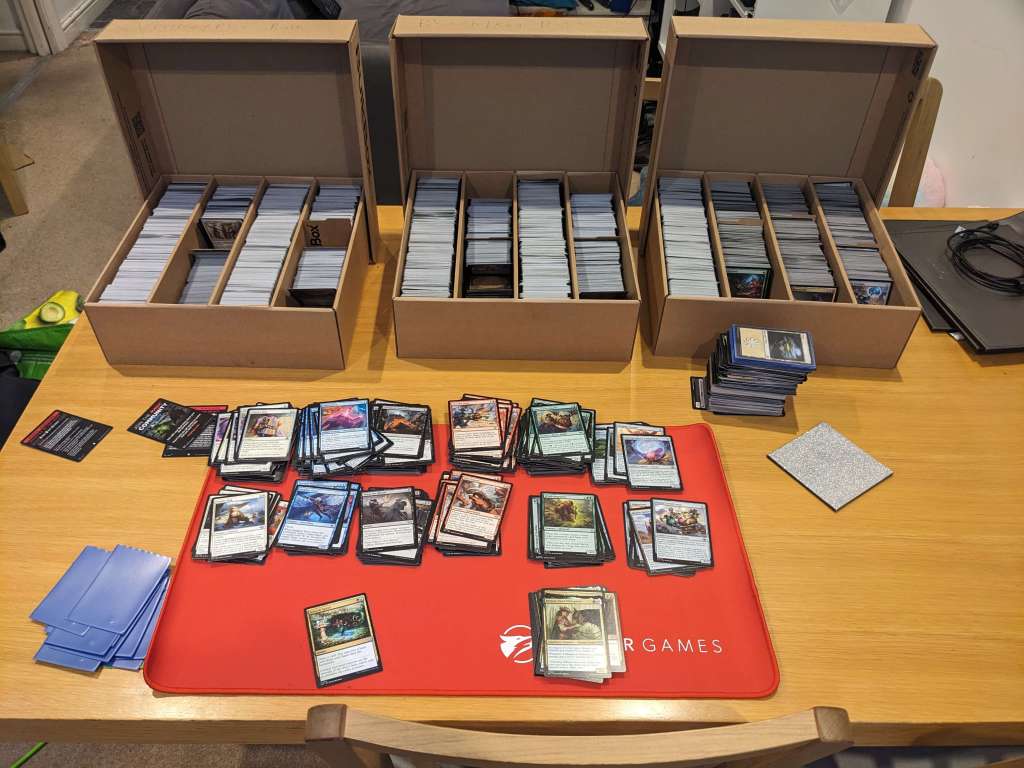
    So as part of my housework list yesterday, I resumed sorting my Magic: the Gathering cards. For those unaware, I own… a lot of cards…

    …possibly even too many one might say… this is not even a full representation of the entire collection, considering the amount of binders and commander decks I own.

    Though with consideration to today’s review subject, pictured above, keeping the collection organised has become easier.

    Those cardboard boxes are called BulkBox QUADs, being able to hold 3600 cards across four channels. They do require some assembly before use, and I will admit to minorly fucking up the construction on one of them but that is not a fault of the video tutorial I followed – created by Bulkbox themselves.

    Before purchasing this product, my cards were stored in a Fenrir Games 5000 count longbox that I had owned since around 2019. It definitely served its purpose for the time I had it but in my current living situation, it was difficult to use it without struggling to find a home for it.

    That is where one of the features of the BulkBox really appealed to me – a set of three QUADs fit perfectly into one IKEA Kallax cube. Having a massive amount of Kallax cube space already in my flat made it the ideal upgrade for my card storage solution.

    Picture taken from BulkBox’s website

    Even with the amount of cards currently spread across all three of the boxes I bought, I do not feel them bowing or bending whenever I pick them up – something I often encountered when needing to move my old 5000 count longbox. Even considering the somewhat botched job I did on construction, the Bulkbox holds up fantastically to the amount of cards I am putting into it.

    That said, I would consider Bulkbox to be premium-priced storage solutions. For a bundle pack of three QUADS (with free UK shipping) cost me £35. I do consider it worth it for serious collectors of cards and Kallax enthusiasts (that Venn diagram is a circle), especially if you want to minimise the footprint your collection has.

    Taking into account the rest of the collection I need to sort, it is likely I will need to buy from BulkBox again, and I know I can be assured of their quality.

    I think that covers everything for today, I am going to go focus on staying cool with soft drinks, frappes, and ice cream. Thank you for reading today, please stay cool and treat yourself to anything that cools you down.

    For more information on BulkBox products, visit their website here: BulkBox the best trading card game storage boxes

  • M:tg Kaldheim Commander Deck Review – Elven Ambush

    Alongside all the different kinds of boosters released with Kaldheim, and continuing what was started with Zendikar Rising, there were two Commander decks released. The one I will be reviewing today is the Green/Black (Golgari) Elf Tribal deck.

    For anyone who may be coming in as a Magic player but not as a Commander player, here’s a quick rules rundown:

    • You start on 40 life as opposed to 20
    • You have a 100 card singleton deck, with one/two legendary creatures designed as the “Commander” of the deck
    • The deck must be in the colour identity of the commander (yes, this include hybrid cards, no using a Simic hybrid card in a green deck)
    • You can cast the commander from the Command zone at any time, paying an n+2 mana cost on top of the card cost, where n is the number of times the commander has been cast this game
    • Alternate win condition of “Commander Damage”: if a single commander creature deals 21 or more damage to a player over the course of a game, they are eliminated

    With that out of the way, let’s dive right in.

    Contents

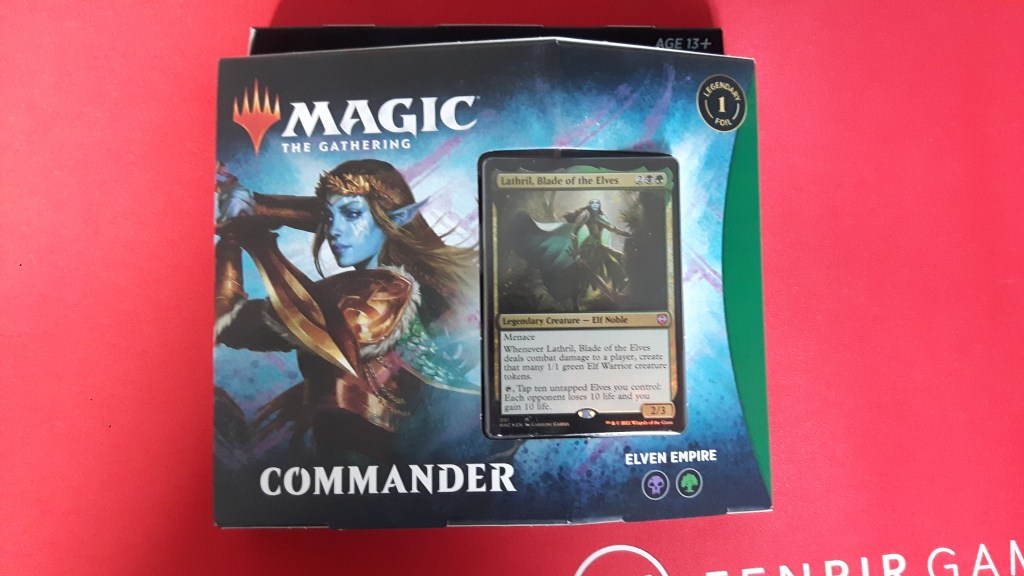
    I purchased this deck from the UK based online retailer Chaos Cards (not sponsored, just a fan), and it cost me £19.95. This sealed deck contains the following:

    • One foil commander card
    • One sealed 99 card deck
    • Ten double-sided token cards
    • One cardboard life wheel (which only goes up to 40 life)
    • One cardboard deck box able to hold 100 sleeved cards
    • And one Commander strategy insert

    Outside of card value, which will be discussed later on, I think this price point is good for a product to accompany Standard legal sets. Since the decks themselves are not tied to the standard rotation and are instead themed after the set, this provides an avenue for low-medium value reprints to be included for players who may need them.

    This price point is also great for players wanting to get into Commander to see how they feel about it. Whilst the ongoing pandemic makes meeting up in groups to play the game incredibly difficult, these being cheaper but less diverse than the annual Commander decks of previous years opens more accessibility to what can be a confusing format. They are almost like the Commander version of Challenger Decks (decks that are built to be standard playable out the box).

    Included Commanders

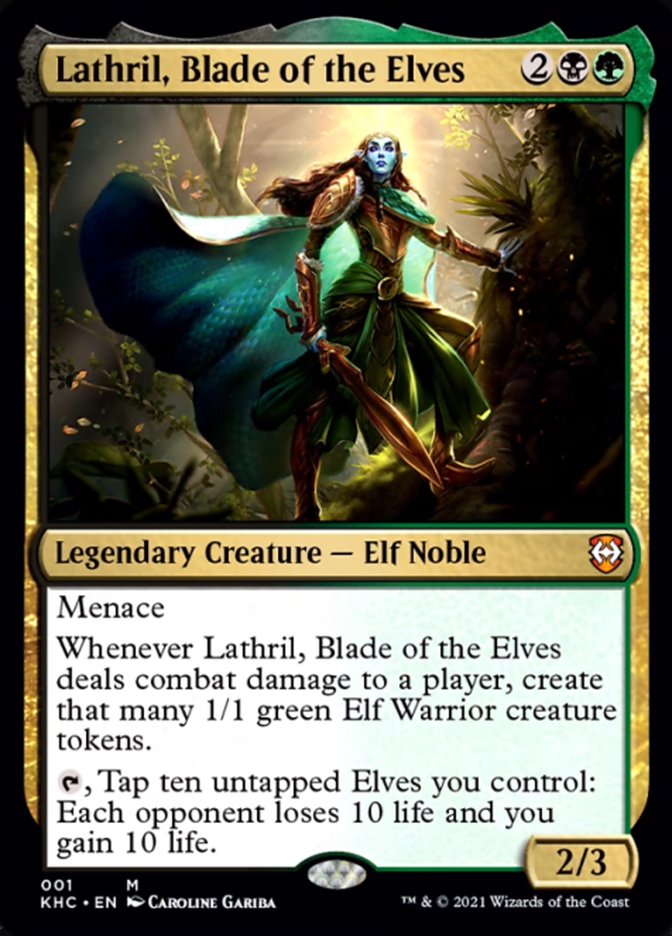
    The “face” Commander of this deck is a new card called Lathril, Blade of the Elves. Like a handful of Elf commander creatures before her, she is designed around getting as many Elves onto the field as possible and then using them to activate a powerful ability. Note that her last ability does not count for commander damage purposes. Menace is a good evasion ability to trigger her token generation, and green is not a colour in short supply of buffs or trample to ensure reliable usage of the ability.

    However, if Lathril is not to a player’s taste, or if they wish to try something new, there are a couple of other legendary creatures to use instead. 

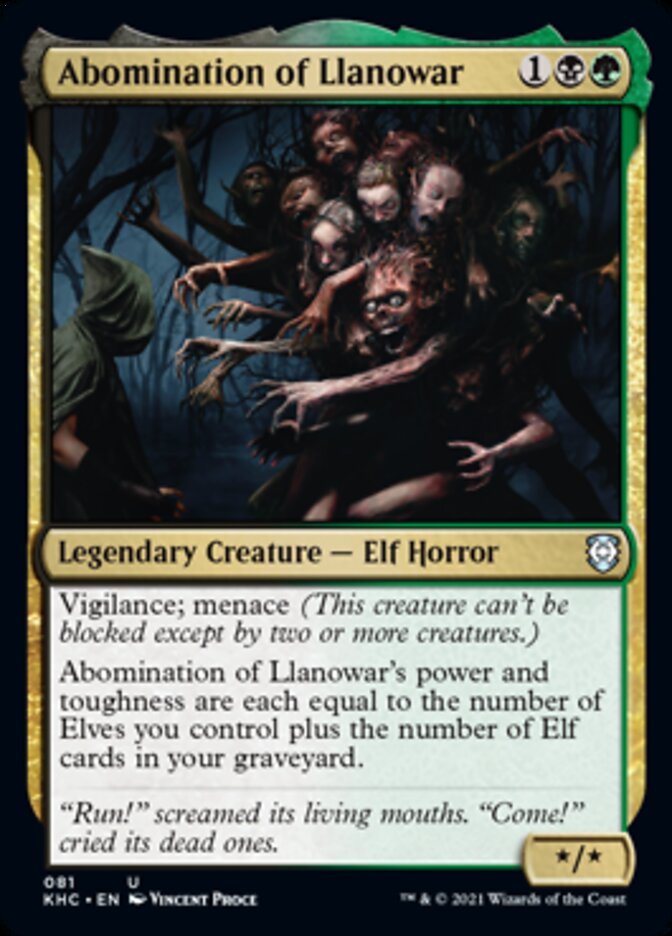
    One of these is the recently printed Abomination of Llanowar, from Commander Legends. AoL is one of my personal favourite new legendary cards within the last year, as it provides both an evasion and defensive ability with Menace and Vigilance respectively. Combine this with the fact that its power and toughness will continue to grow as Elves enter and Elves die (minus tokens), and you have a literal Elfball that could oneshot players.

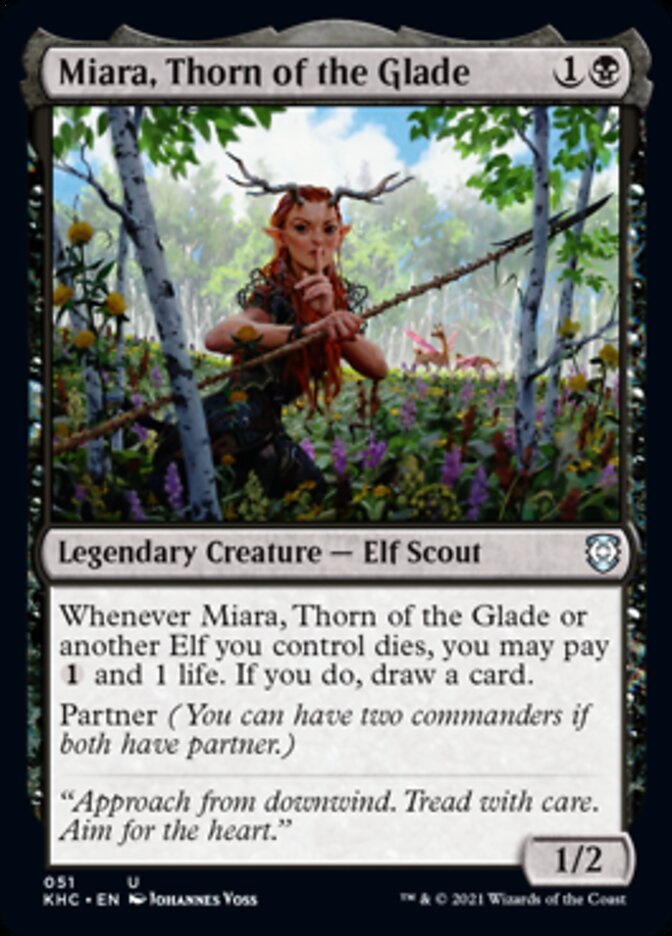
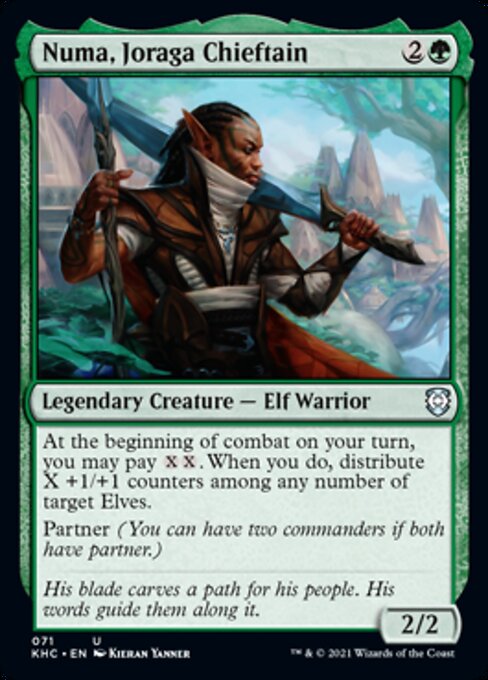
    Also included from Commander Legends are the Elf partner commanders, Miara, Thorn of the Glade and Numa, Joraga Chieftain. Miara synergises nicely with Elf token generation, and her ability being a “may” trigger lets players control how much damage they want to take in exchange for cards. Mana is unlikely to be an issue in an Elf deck, both for green ramp and mana dorks.

    Numa herself is more focused around this aspect of an Elf deck, as her somewhat steep cost of {X}{X} can give needed buffs to other Elf creatures but will not see massive returns until later on in the game. That said, it can be quite easy to underestimate how much a single +1/+1 for two mana per combat phase can snowball, so keep that in mind as well.

    Newly designed cards

    Including Lathril there are eight new cards included in this deck, entirely separate from the new cards added in Kaldheim. I will be highlighting a few of the powerful ones and some of the ones I like.

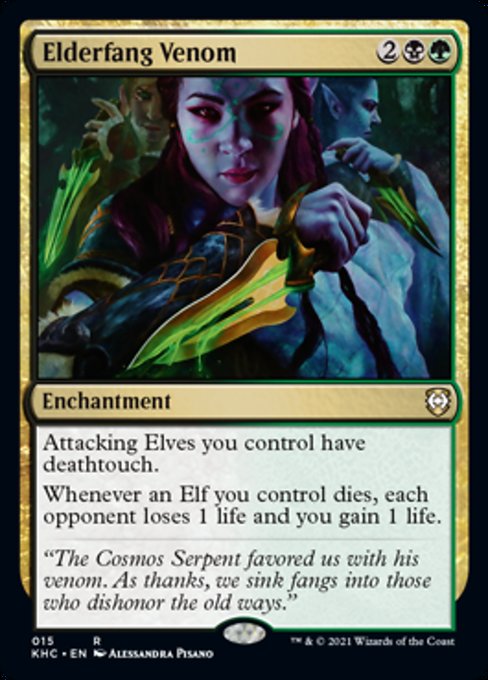
    Elderfang Venom is a great card for forcing difficult blocks on opponents using smaller creatures, especially tokens. Either way, an opponent is going to be losing some life out of the combat phase as they will either let the creatures through to their life, or they will be blocking some Elves, killing them off and triggering the second ability.

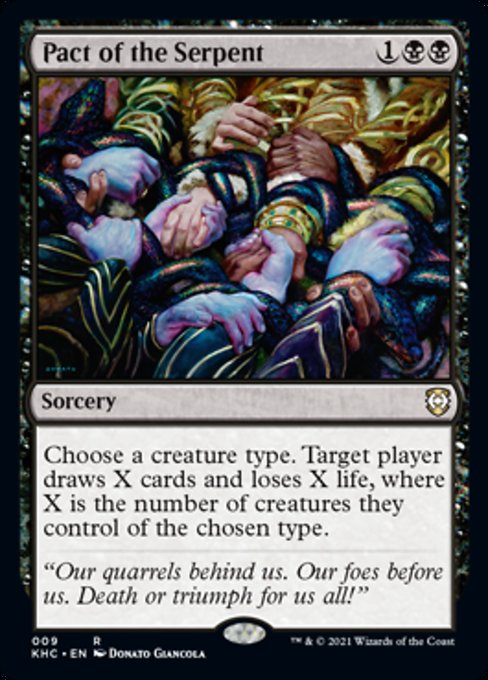
    This lifegain synergises well with Pact of the Serpent, though the main reason I like this card is its potential for versatility. Obviously the intended purpose is sacrificing your life in exchange for cards as a reward for tribal devotion, but it can also qualify as anti-tribal tech, where you play it on another tribal opponent to deplete their life and potentially make them overdraw, forcing them to discard valuable cards.

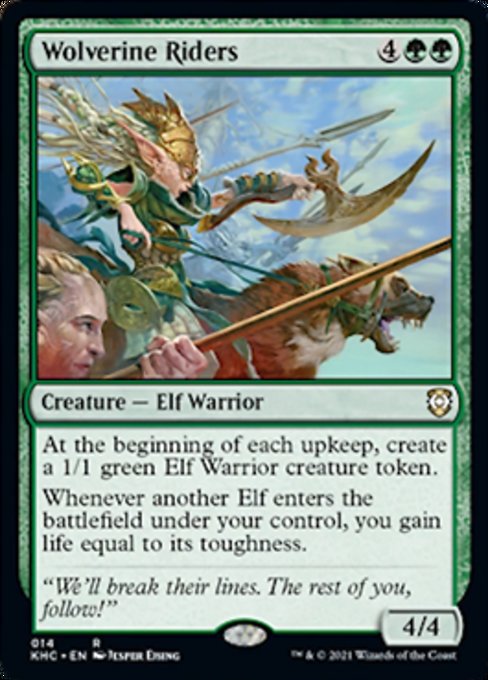
    With a commander focused on token generation, Wolverine Riders provide an incredibly reliable source of Elves to fuel other card’s effects and the generation being on each upkeep keeps a good supply of chump blockers around. Six mana can be quite a steep cost for some but in a deck with a good amount of mana dorks it should not be a major roadblock.

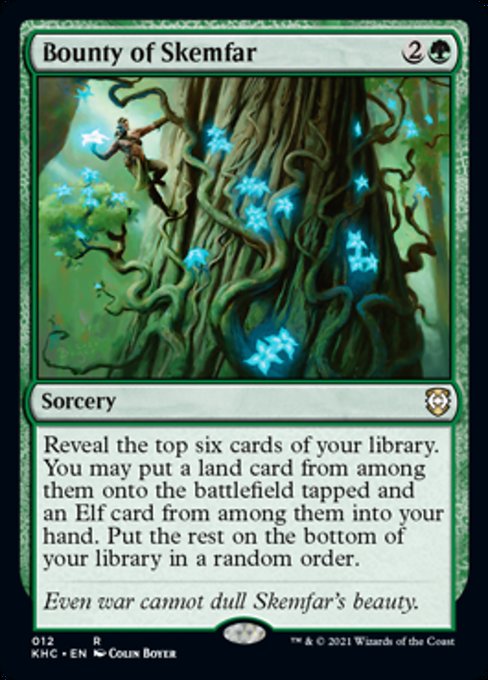
    And finally, Bounty of Skemfar is a great alternative to a ramp tutor that integrates well with the tribal theme of the deck. Given the average land composition of a commander deck and the ratio of creature-to-noncreature cards in a tribal deck, it is unlikely that a player would fail to find on either front, and if they do… well, they have my sympathies

    Theme booster cards

    In a pleasant addition, three cards that would normally be exclusive to Theme and Set boosters are included in this deck, providing an easy avenue for players to acquire them in addition to other high value cards.

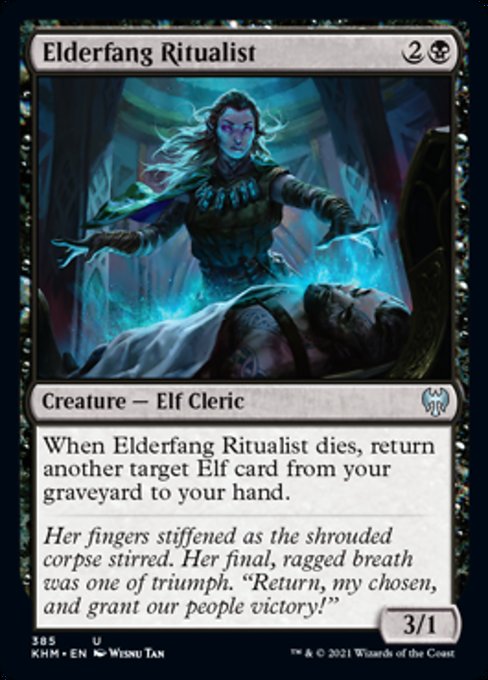
    Elderfang Ritualist is a great uncommon inclusion, providing a decent power stat on a creature designed to die and allow for high value two-for-one trades. However, the other two cards are of note, especially when compared to other inclusions in the deck.

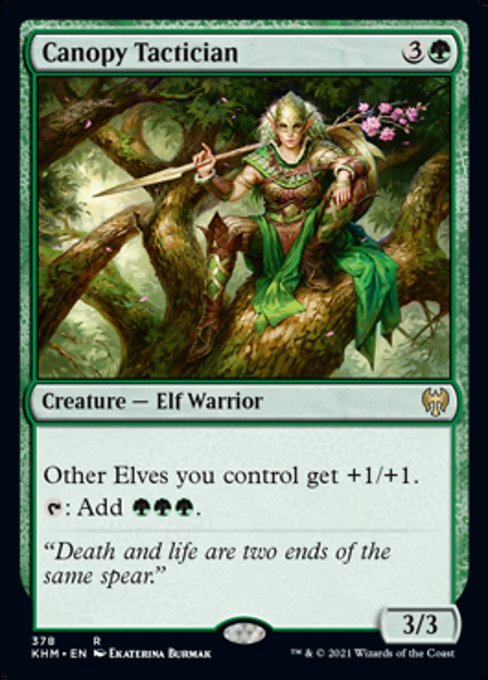
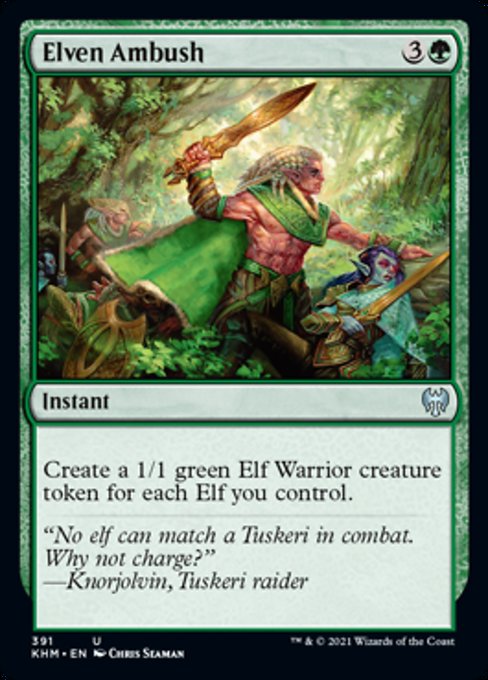
    Canopy Tactician and Elven Ambush are both cards that definitely need to be included in a deck like this. The former is a very relevant anthem effect with an insane amount of ramp in comparison to its cost, and the latter can be used to create chump blockers in a pinch or instant-speed buff something like Abomination of Llanowar.

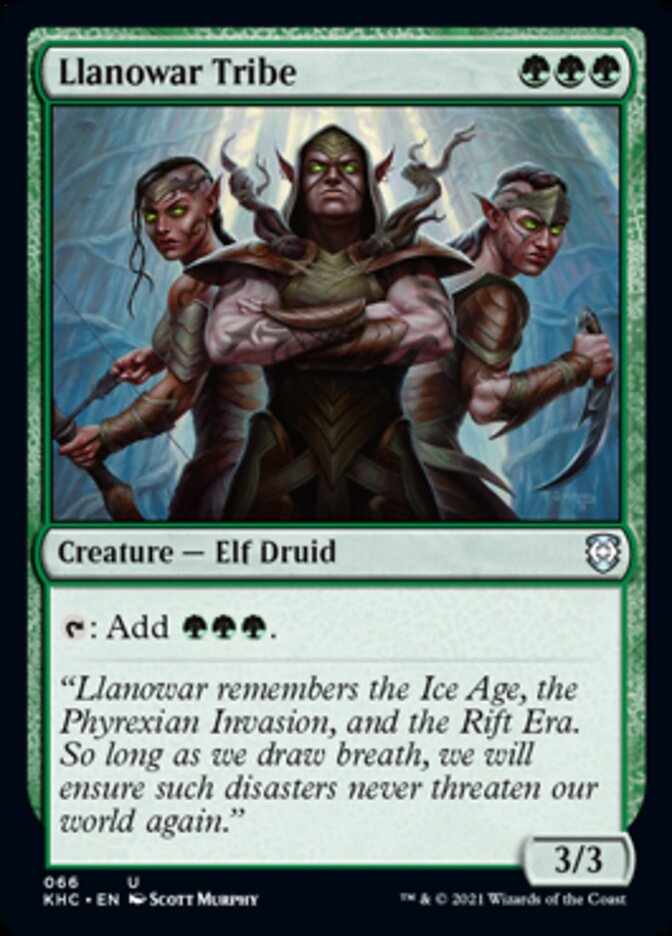
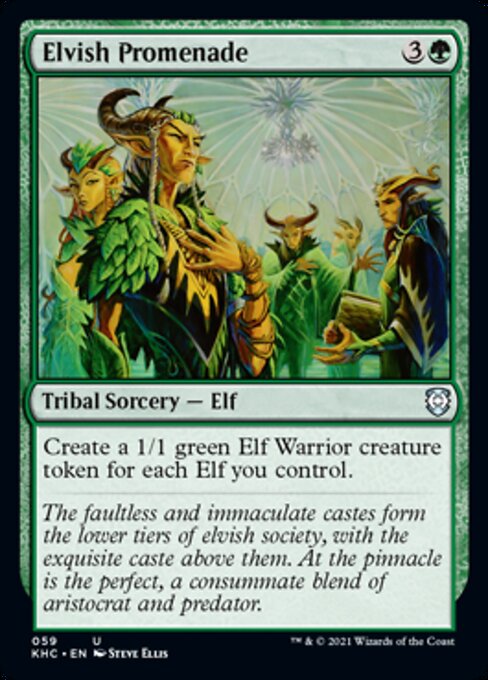
    But then you compare them to Llanowar Tribe and Elvish Promenade, which are also included in this deck. Again, these cards both fit perfectly into a deck like this, especially seeing as Promenade is a high value reprint, but the power creep of recent years is exemplified when you compare them within the same deck, and seeing what cards do more in comparison to mana cost.

    Reprints

    As mentioned, Elvish Promenade is an incredibly welcome reprint in this deck, with a period of almost seven years having passed since it was last seen (Duel Deck Anthology), and having the reprint being in a widely-available sealed product helps the impact this reprint brings.

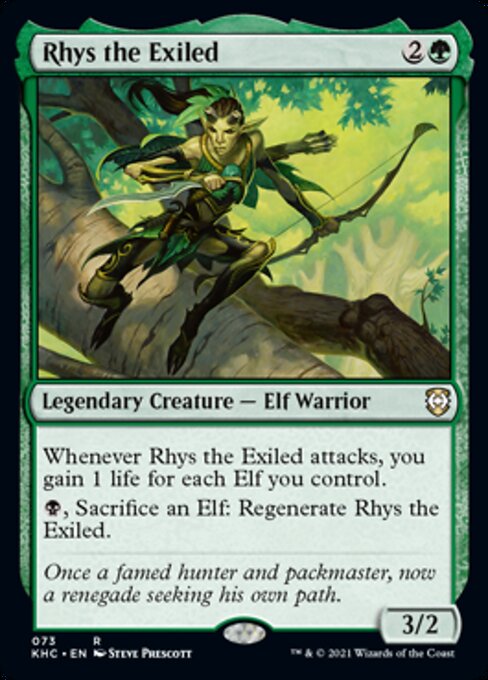
    Potentially even more welcome is the first-ever reprint of Rhys, the Exiled. Originally printed in Morningtide over twelve years, Rhys is a massive inclusion in a product such as this as he both fits amazingly well within the theme of the deck, and he can potentially act as the commander too.

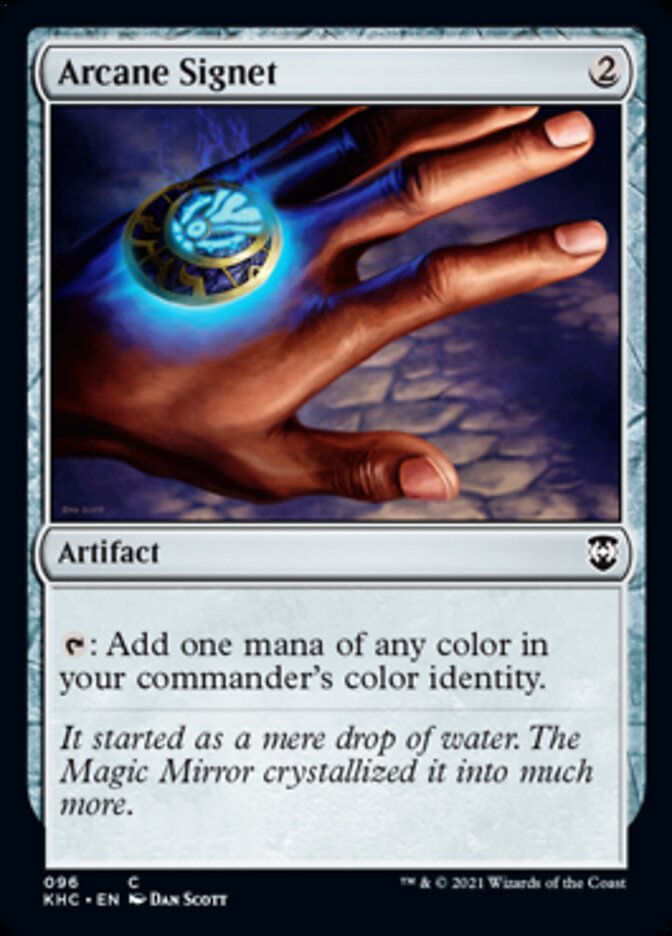
    Arcane Signet and Sol Ring are about as staple to commander as banlist debates but considering both cards average around the $2-3 mark consistently, their inclusion is welcome for players who may need more copies and for players who can use them to make good trades.

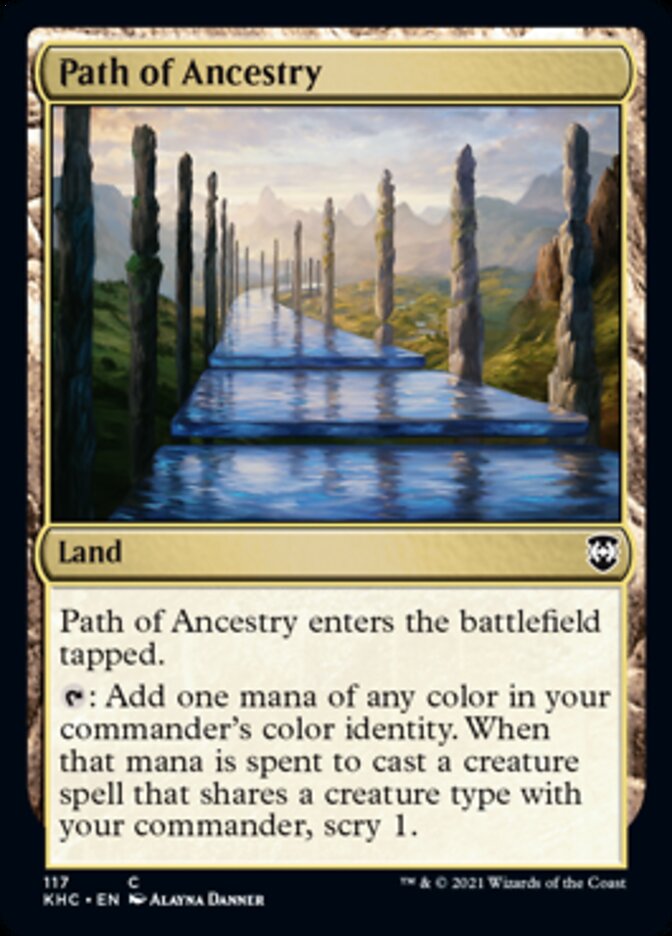
    And whilst it is nowhere close to being a valuable reprint due how recent its inclusion in Commander Legends was, I do like seeing Path of Ancestry appear. Up until recently it was quite a difficult card to get a hold of at a reasonable price, so seeing a sensible attitude taken to its inclusion in sealed products warms my tribal heart.

    Lands

    However, such praise cannot be shared for the rest of the land base in this deck. I’d go as far to say that Path of Ancestry is in contention for being the best land in the deck, alongside Command Tower.

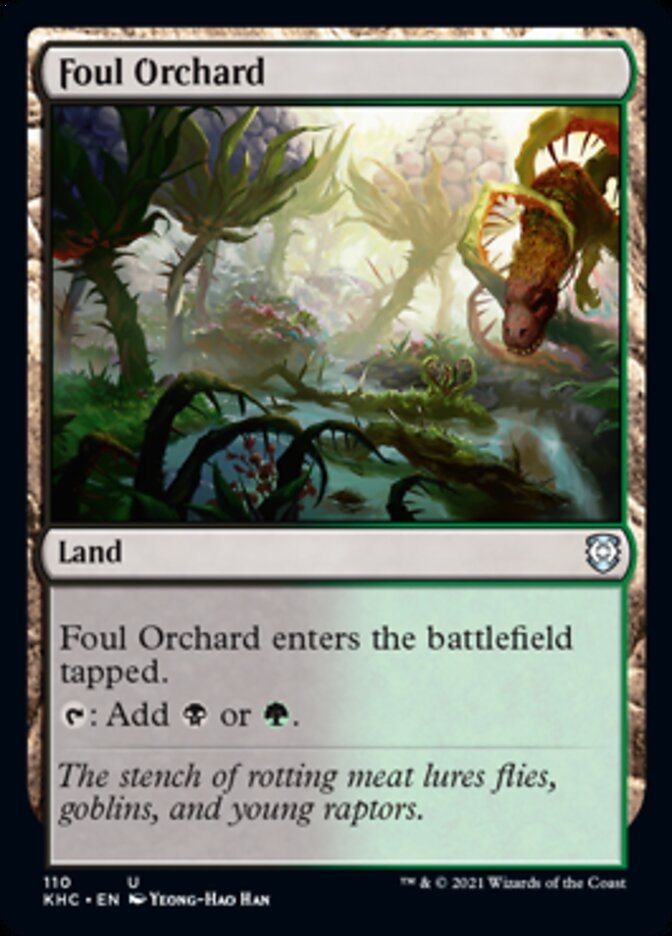
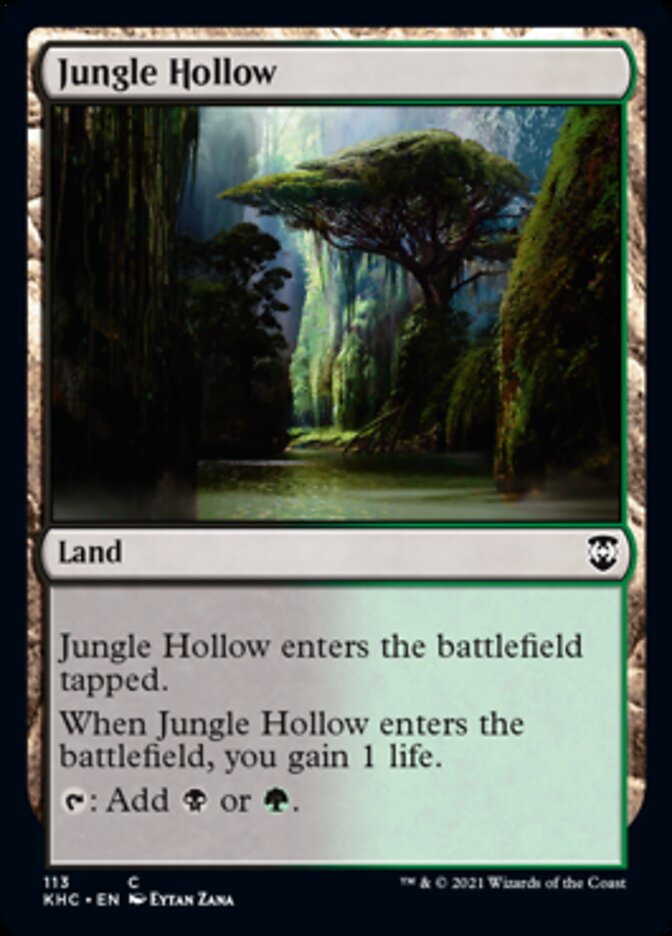
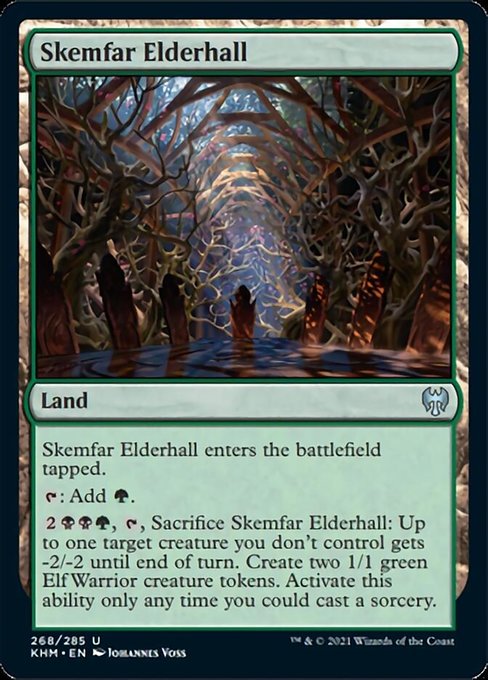
    29 out of 37 lands in this deck are basic Forest and Swamp cards. Path and Tower make up 2 of the remaining 8 nonbasic lands in this deck, and what do players get in the remaining six lands?

    • A boring tapland (Foul Orchard)
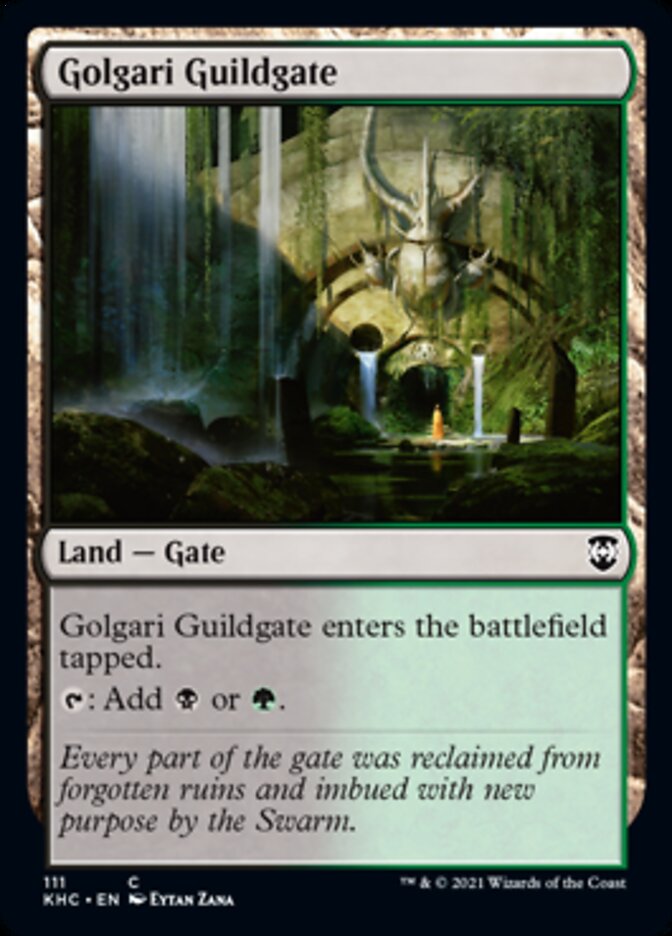
    • A boring tapland 2: Golgari Boogaloo (Golgari Guildgate)
    • A boring tapland that gives one life (Jungle Hollow)
    • A mono tapland found in the main Kaldheim set (Skemfar Elderhall)
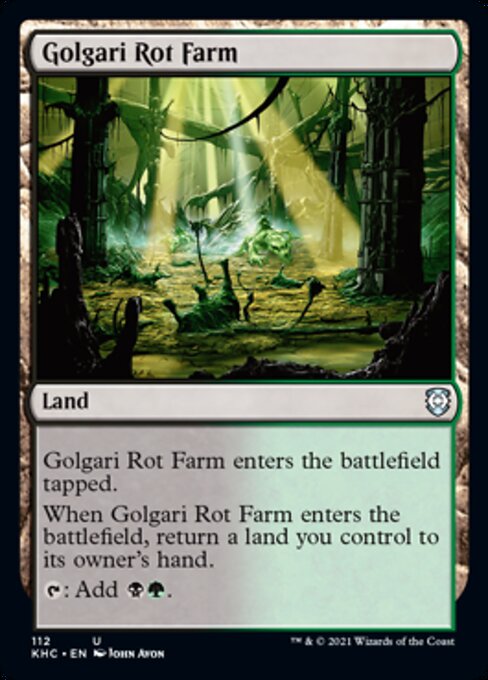
    • A less boring tapland that has nonetheless been reprinted enough (Golgari Rot Farm)
    • And a tapland I personally like a lot but using the less good art (Myriad Landscape)

    Whilst I understand that this is a budget product and the land base is not likely to have cards such as shock lands or filter lands, there are still some cards that would have fit perfectly in a deck such as this and either not break the budget, or provide another needed reprint:

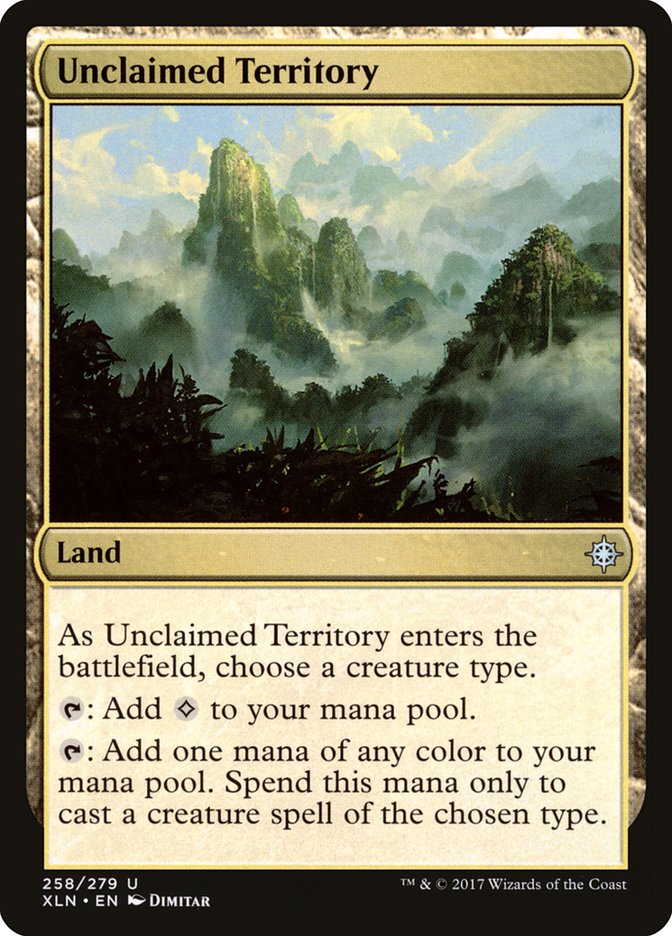
    • Unclaimed Territory is a great mana fixing card for tribal decks and trends around the $1-2 mark
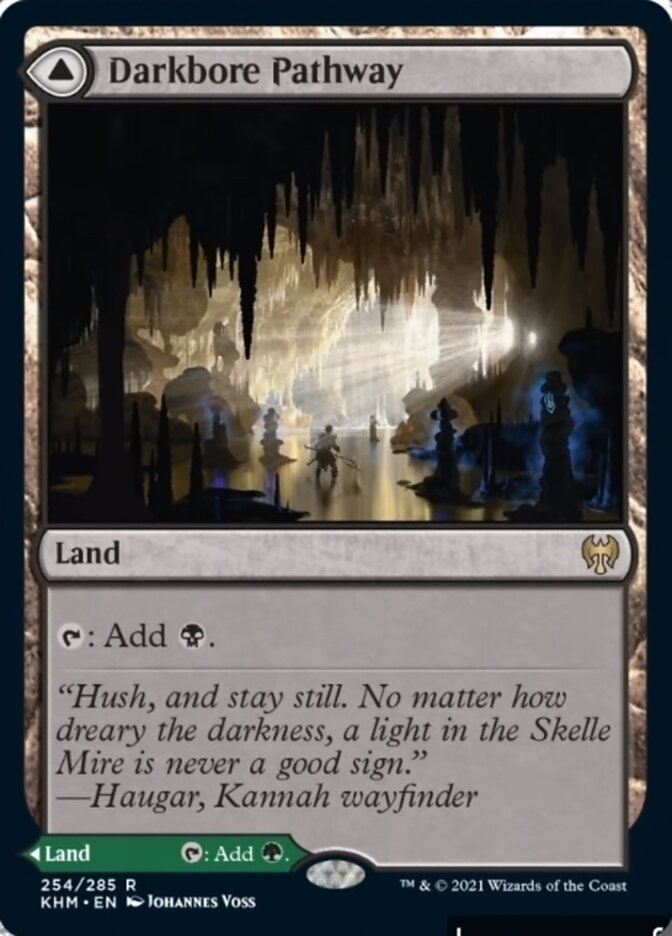
    • Darkbore Pathway/Slitherbore Pathway would be a great way to include the modal double-faced cards that Kaldheim places a lot of emphasis on
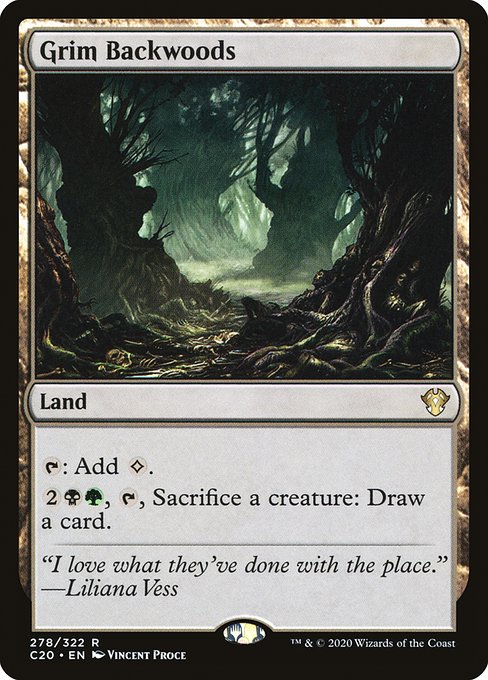
    • Grim Backwoods is not a card in need of a reprint, however it would have brought great diversity and interest to a deck that has the potential to sacrifice Elf tokens for great gain
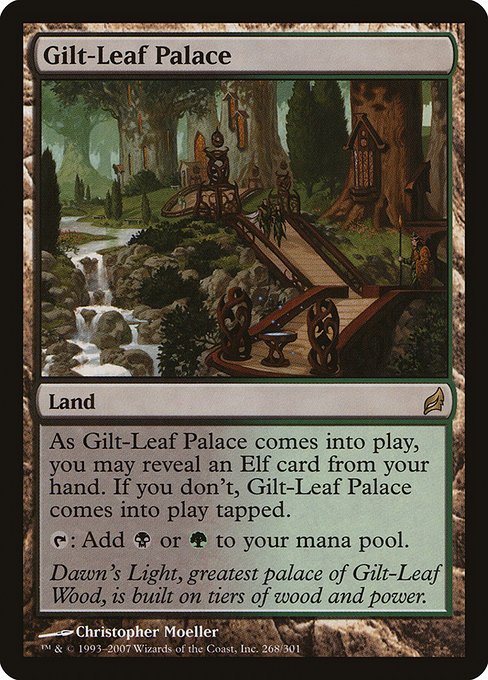
    • And finally, Gilt-Leaf Palace is crying out for another reprint. Both Lorwyn and Mystery Booster versions are trending around the $10-11 mark so inclusion in this product would have brought a welcome price reduction

    Verdict

    Whilst the land base is lacking in many areas, it does not detract from the overall value this product provides. With a few high value reprints, well-designed (if power creepy) original cards, and space for more experienced players to upgrade to their desired specifications, this Kaldheim Commander deck is a fantastic purchase at or around the £20 price tag. 

    One final bit

    This isn’t related to the review or anything, but as I was drafting this review out I wrote the contents section and filled it with a few silly throwaway jokes… problem is I find my own joke here too funny for my own good, so I feel a need to include it here now.

    Also this time I used the “Gallery” block quite a bit to make sure all the cards looked good/lined up, as opposed to what I did for my pre-release article. Hopefully it is both clear and nicely laid out for everyone.

  • MtG: Kaldheim Prerelease Review/Build

    Introduction

    Kaldheim is the first set of 2021, taking inspiration from Norse Mythology and Viking Folklore to create their major themes. As such backstory is rich in different types of creatures, Kaldheim is a tribal set with ten different tribes, each corresponding to their own colour pair.

    Whilst people may not be able to gather currently to play in a prerelease tournament, the boxes are still on sale for people to add them to their collection or to take part in virtual prereleases. The one I bought was acquired from the UK retailer Troll Trader Cards (not sponsored, just a fan).

    So, I decided to record what I opened this time and try build a deck out of it. Will I have built a deck worthy of the top prize? Or am I doomed to enter the Milkshake Bracket once more?

    Set Mechanics & Quick Review

    • Returning – Tribal Mechanics: Pretty straightforward, different creature types have bonuses based on other creatures of the same type being in play. Tribes are humans, spirits, zombies, demons, trolls, giants, angels, elves, dwarves, and changelings (all creature types simultaneously)
    • Returning – Snow Mana: Mana produced by a Snow permanent can be used to pay for other Snow cards or activate abilities requiring Snow mana
    • Returning – Modal Double-Faced Cards: Double-sided cards that can be played as one side or the other from the hand, cannot shift during play
    • New – Foretell: Think of it like Morph for all sorts of cards. Foretell cards are exiled from hand by paying two mana, and then can be played for a “Foretell” cost later on, sometimes having additional benefits if a card was foretold
    • New – Boast: An ability that can be activated once per turn and can only be used after a creature has attacked (note: attacked, meaning this can be used in response during combat)

    Being the first fully tribal set since Ixalan block, Wizards of the Coast had a lot to learn from the missteps that set made. (Rosalia’s note: this sentence hurts to write because as much as it is true, this is the set that I got into Magic on, and gave me my favourite tribe of Merfolk. I’m sorry Ixalan T_T)

    In my opinion Kaldheim learns from these mistakes and sets up a standalone tribal set on a par with Lorwyn block. Each tribe being assigned to a colour pair allows for less hoarding of one particular tribe during a draft, and the additional of changelings in Simic provides more versatility to change path and/or shore up a struggling tribal deck.

    Whilst I appreciate the inclusion of God cards from a Commander perspective, there are some strange design choices around their inclusion. This is especially highlighted in the card “”Forging the Tyrite Sword”, which I find strange for being a card that references a specific card by name. Designs like this in draft are fun to chase after, in theory, but ultimately dilute the pool of usable cards.

    Speaking from the commander perspective entirely, there are some amazing legendary creatures in this set, especially at the uncommon level. Whilst it does lead to some power creep in certain areas, having more good legendary cards at uncommon grants more accessibility into commander and expands the potential for budget decks.

    Promo Card

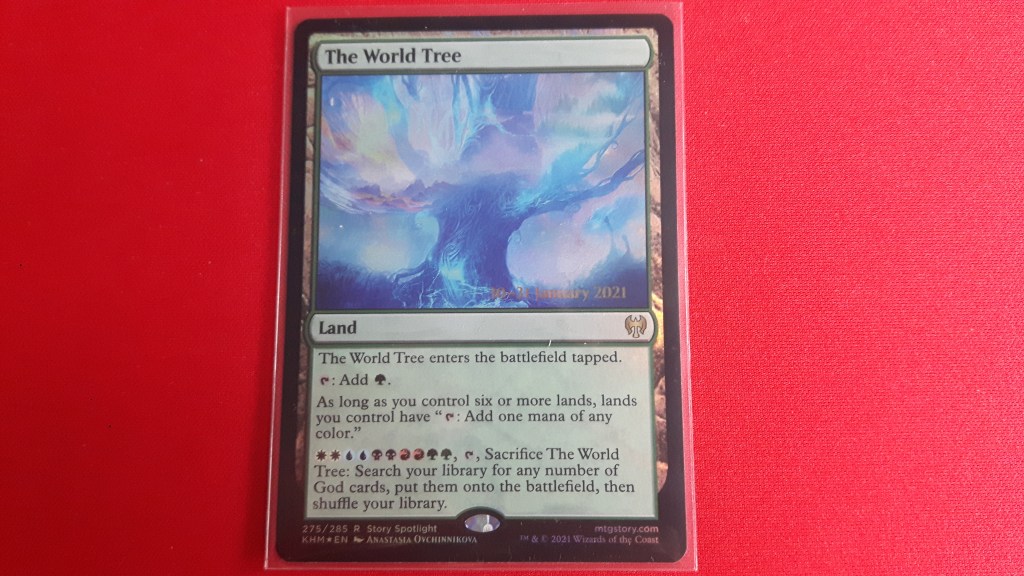
    Taking inspiration from Yggdrasil itself, the World Tree is a pretty nice card to open as a foil promo. It gives a surprising amount of versatility in a draft environment mainly for the middle ability, as it provides an unconditional mana fixing solution after the sixth land. The last ability is unlikely to see much use, more for the steep activation cost as opposed to the actual effect.

    Pack 1

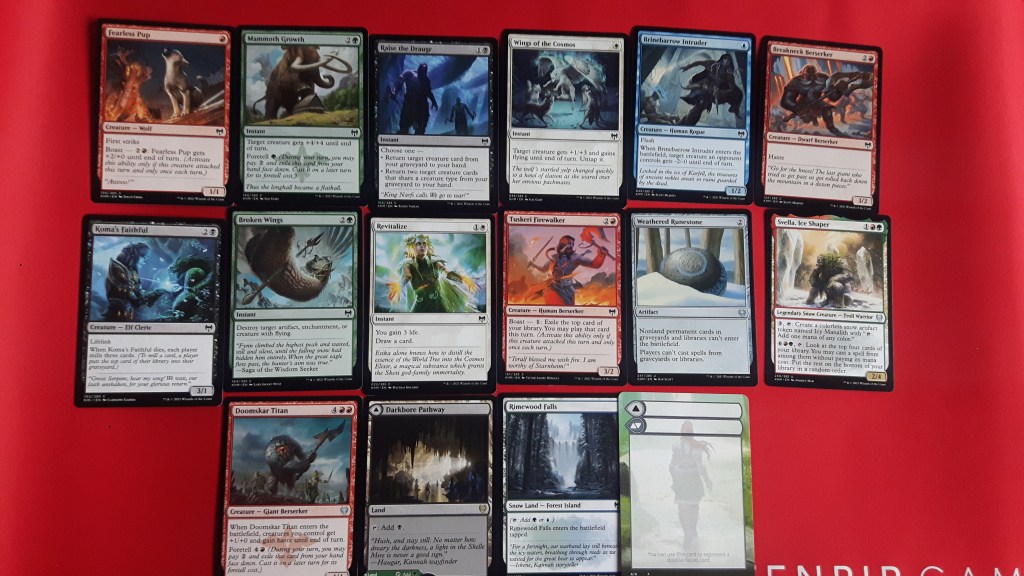
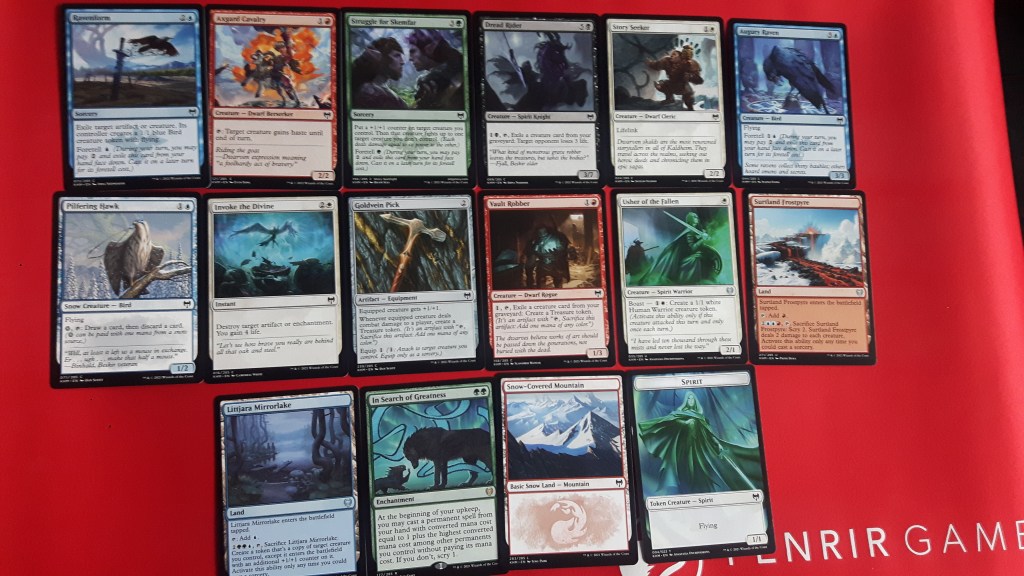
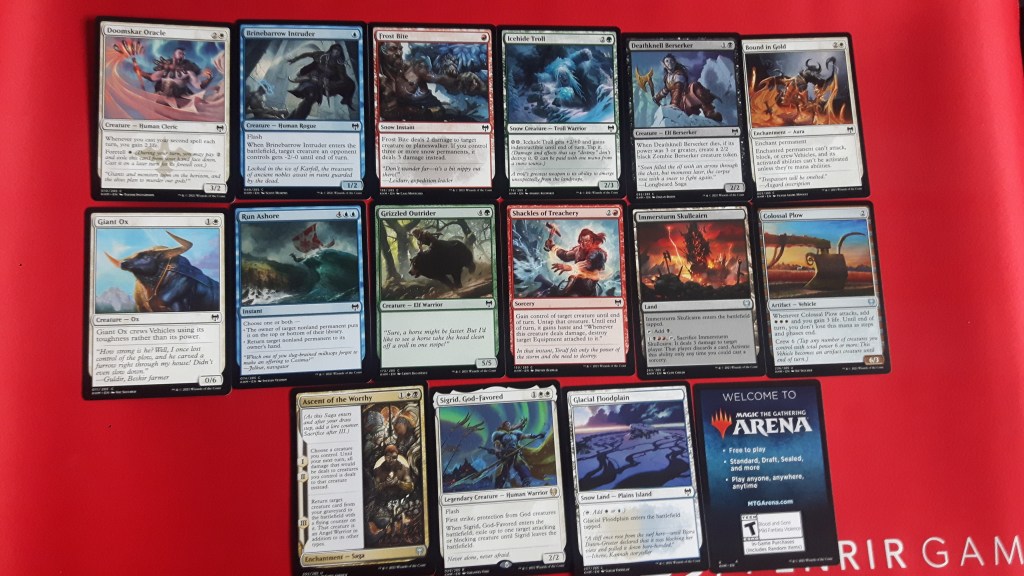
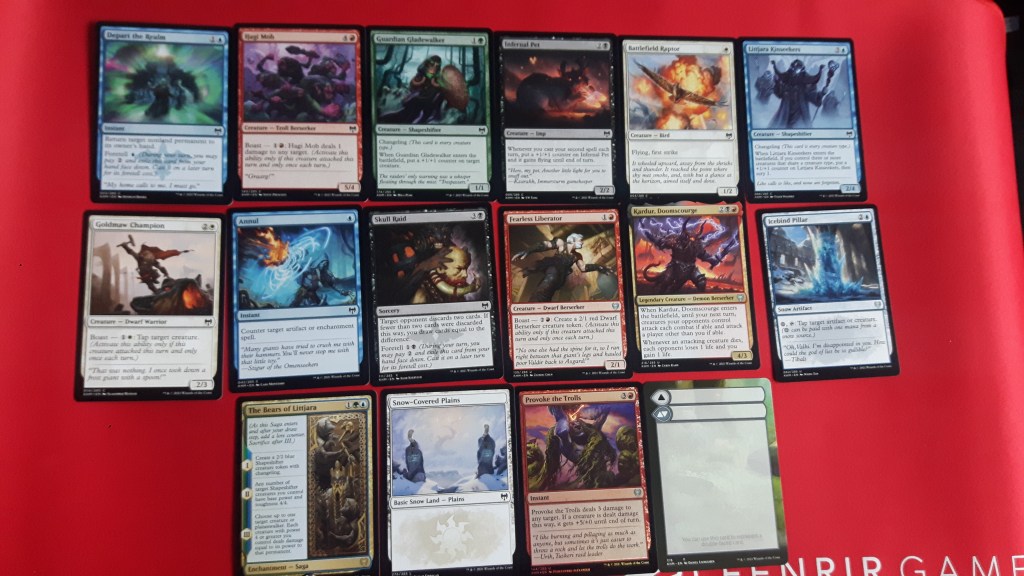
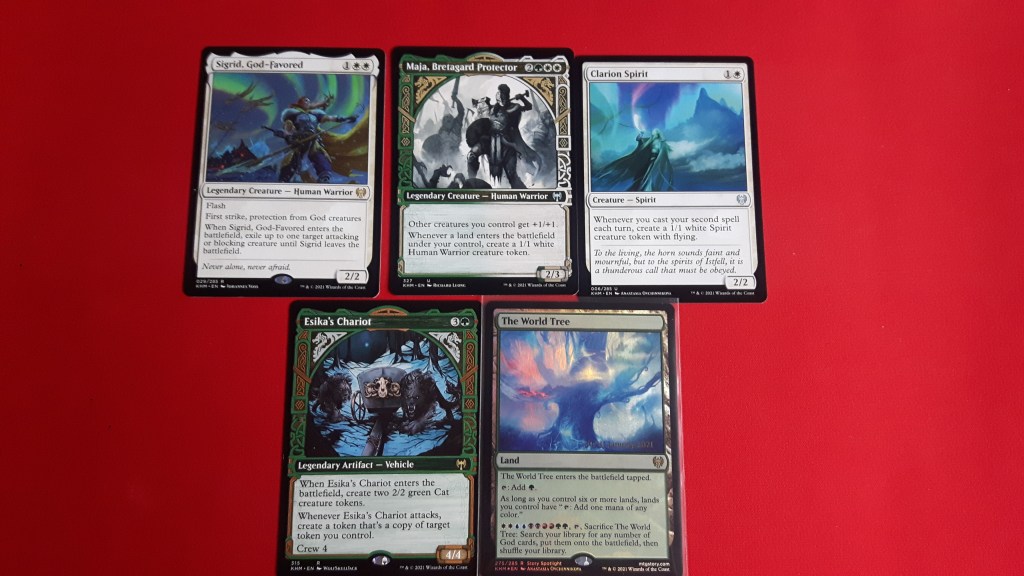
    Two major potential bombs right off the bat in the first pack. Both Eskia’s Chariot and Maja, Bretagard Protector are very powerful cards in a limited environment. Maja’s cost holds her back from being massively impactful but both cards ability to constantly generate additional value gives heavy indication towards building Green/White.

    Pack 2

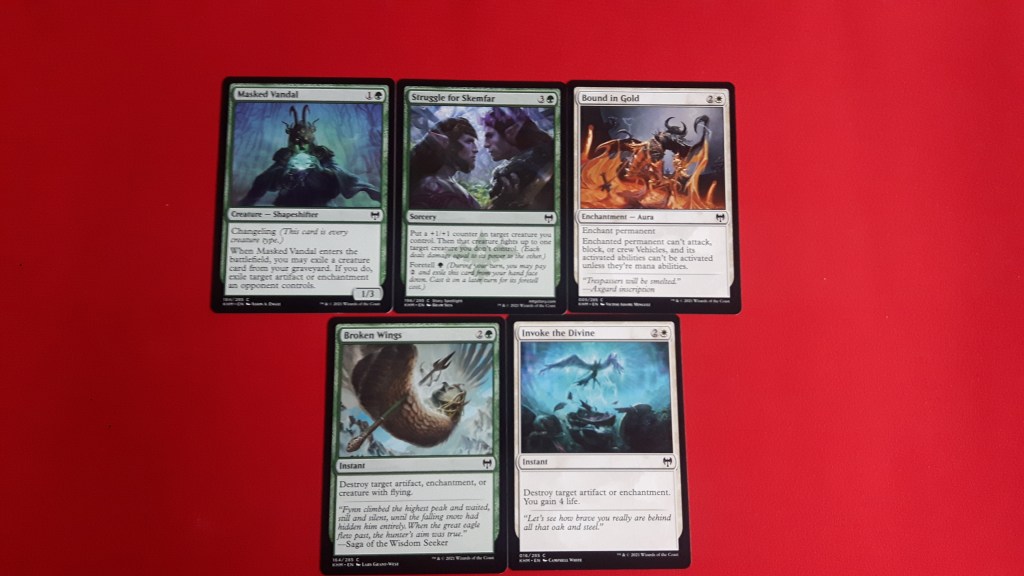
    Pack 2 brings further indicators towards a green deck. Masked Vandal is a good cheap creature with the additional benefit of potentially removing an opponent’s threat, and Path of the World Tree is a decent pick considering this deck has the actual World Tree and can activate the last ability after a period of time.

    Pack 3

    Broken Wings is a great piece of green removal to find in Pack 3, especially as it offer more versatility than a Plummet or Naturalise would in the same setting. The Golgari modal double-faced land provides an out into expanding into said colour pair with a great piece of fixing.

    Pack 4

    In Search of Greatness is… an interesting card in a draft environment. With a focus on low mana creatures it could provide some rapid and aggressive tactics in the right deck, but it would require a very specific sort of deck. Usher of the Fallen is a great aggro pick for a potential green/white deck, being a cheap creature that can be used to generate more value.

    Pack 5

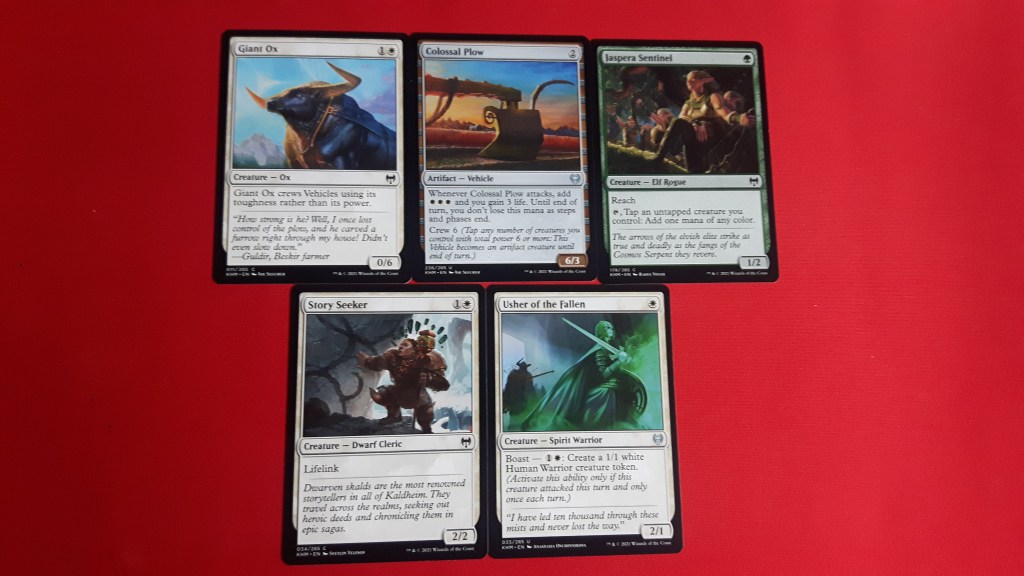
    Giant Ox and Colossal Plow in the same pack? And a fantastic white rare bomb? That settles it, this is going to be a green/white deck. The Giant Ox and Colossal Plow combo may not even be that good, but the fact they came in the same pack seems almost like a sign for me.

    Pack 6

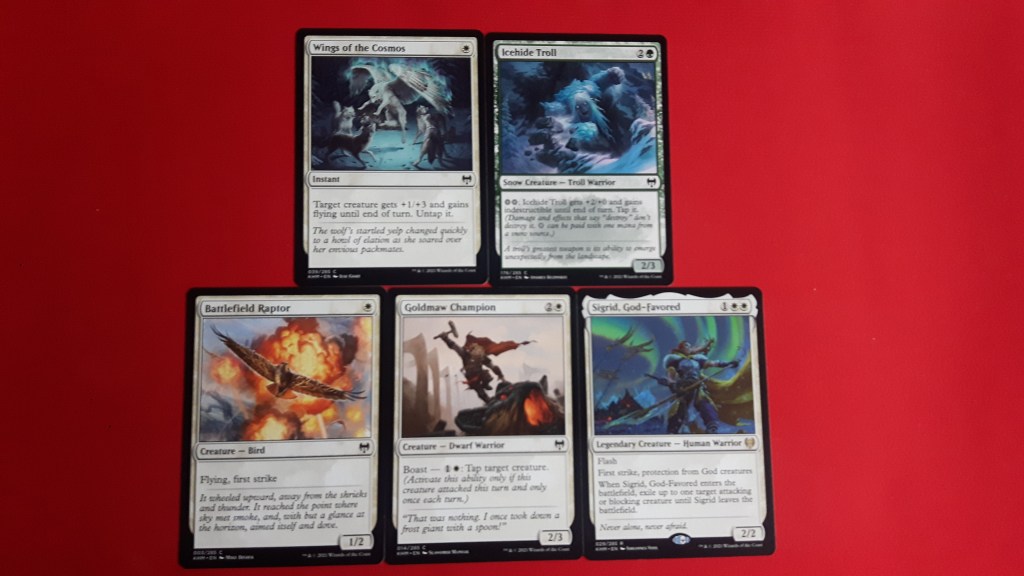
    And finally, we finish off with two decent white evasion cards but not a whole lot else. Battlefield Raptor is a great early game card to start putting pressure on an opponent (similar in a way to Healer’s Hawk from Ravnica Allegiance), and Goldmaw Champion can use it’s Boast ability during combat to potentially remove a powerful blocker.

    Deck Building

    For this deck build, I’ll be running through the BREAD acronym to go through how I built my theoretical prerelease deck. BREAD stands for:

    • Bombs – Powerful cards, usually at rare, that make an impact the turn they are played
    • Removal – Cards that are able to get rid of an opponent’s permanent without much fuss
    • Evasion – Flying, trample, unblockable. Anything that gets past an opponent’s defenses and to their life
    • Aggro – Cheap, effective creatures that can be played on curve and start putting pressure on an opponent’s life total
    • Duds – Usable cards, but definitely not the first choice. Normally used to fill up a deck near the end.

    B – Bombs

    Sigrid and Eskia’s Chariot are definitely my most powerful cards here, with Sigrid being a removal bomb with First Strike and a relevant protection ability in this set, and Eskia’s creating more value as time goes on. Clarion Spirit and Maja are less potent, but the amount of value each can generate in addition to the anthem effect of Maja can lead to extremely powerful boards.

    R – Removal

    Bound in Gold is your expected Pacifism type card in a set, with the very relevant point of it being unable to crew vehicles or activated abilities, completely locking a creature down. The potency of Broken Wings has already been discussed, but Struggle for Skemfar is a Hunt the Weak with a potential discount if it is able to be foretold.

    E – Evasion

    Sigrid appears again for her First Strike and protection ability, but aside from the cards discussed during pack opening there is very little else. Goldmaw Champion can tap something down but this cannot be used on an opponent’s turn due to the limitations of boast, and Battlefield Raptor is a good early start but can be quickly outpaced.

    A – Aggro

    It is not a good combo, but Giant Ox and Colossal Plow is something I want to run in this deck, and Ox is a decent early game creature that can hold up as a blocker for a good part of the early-mid game. Story Seeker is the best card here, as a two mana 2/2 with a very good keyword ability, Lifelink providing a bit of longevity as it attacks or blocks.

    D – Dregs, Duds, or Da Rest

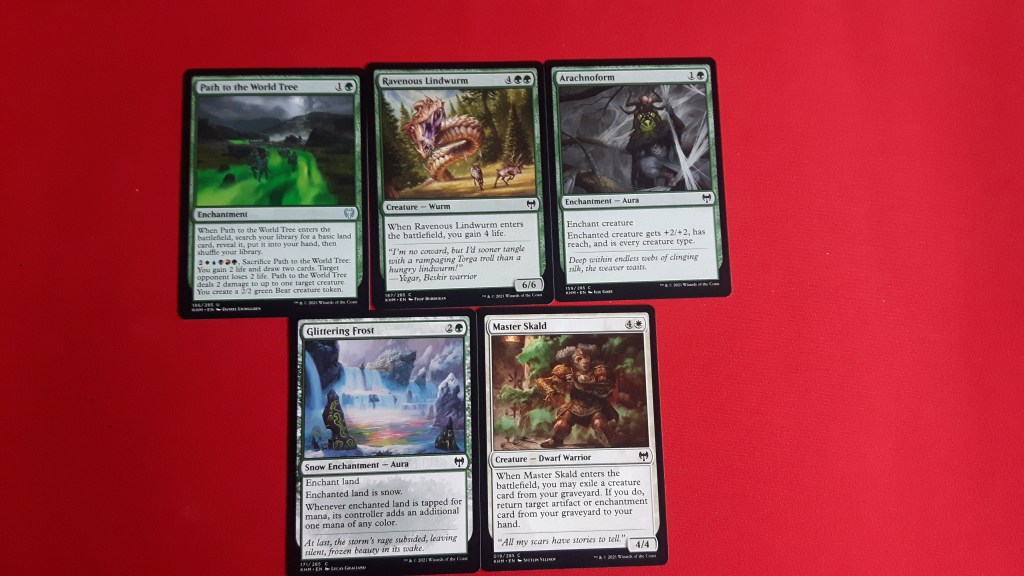
    As we come to the final five cards, we find some usable cards but nothing entirely great. Path to the World Tree provides some function due to the fixing The World Tree provides. Ravenous Lindwurm is a decent stat body with a reasonable ability, but it is no Colossal Dreadmaw. And finally Arachnoform can be used to enhance a strong blocker like Giant Ox, or to give a bit more aggression/pressure on Battlefield Raptor.

    Final Deck Evaluation

    This is… not a great deck honestly. There is a handful of good cards that would provide an impact on the field when played but there is very little in the way of solid core cards to provide a decent early game to give way to those cards. If this was in a four round prerelease tournament at my FLGS I reckon I would go 1-3, not exactly Milkshake Bracket territory but still far from how I have placed before. Let us see what my consolation prize packs would have been then:

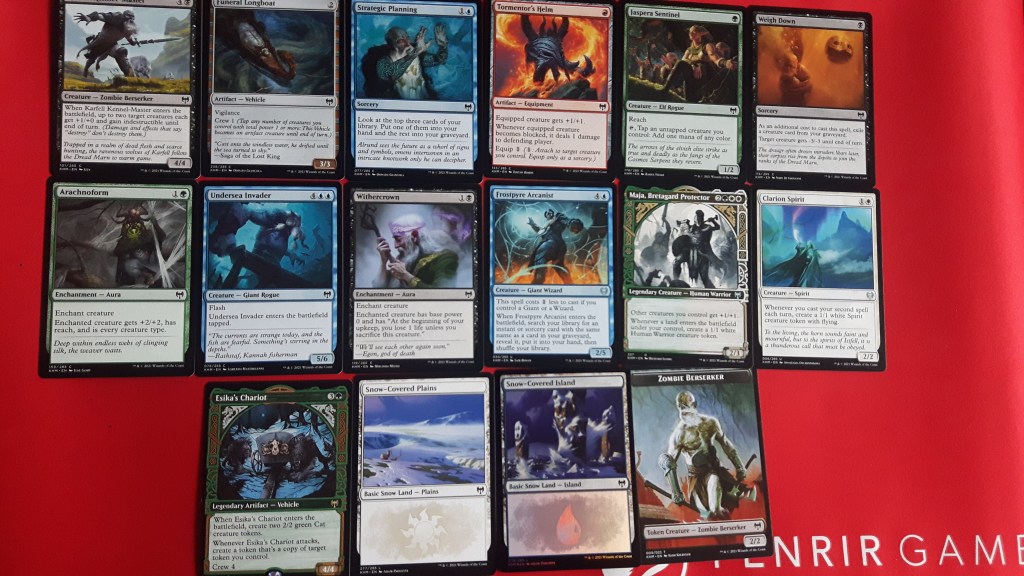
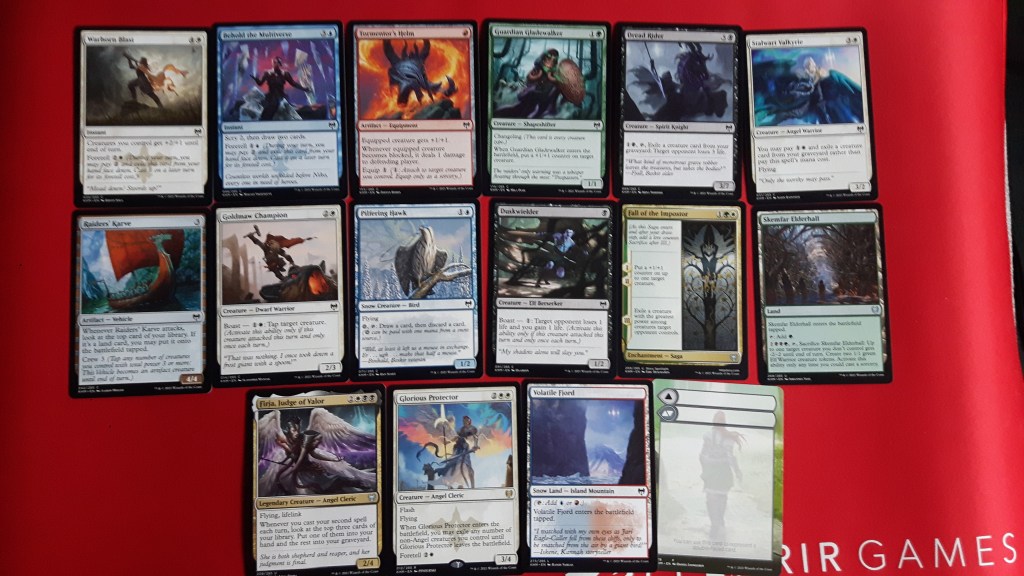
    Prize Pack 1

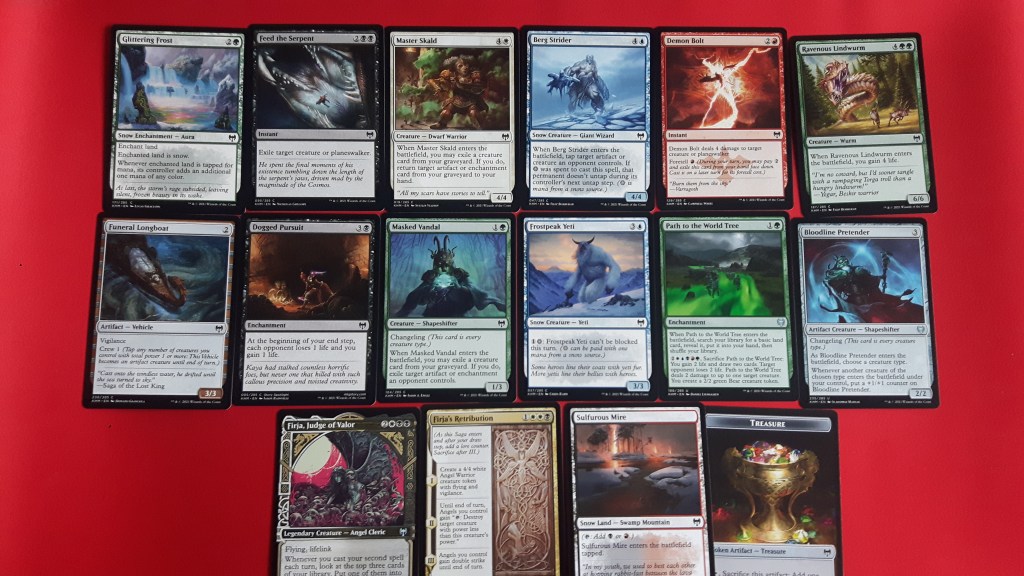
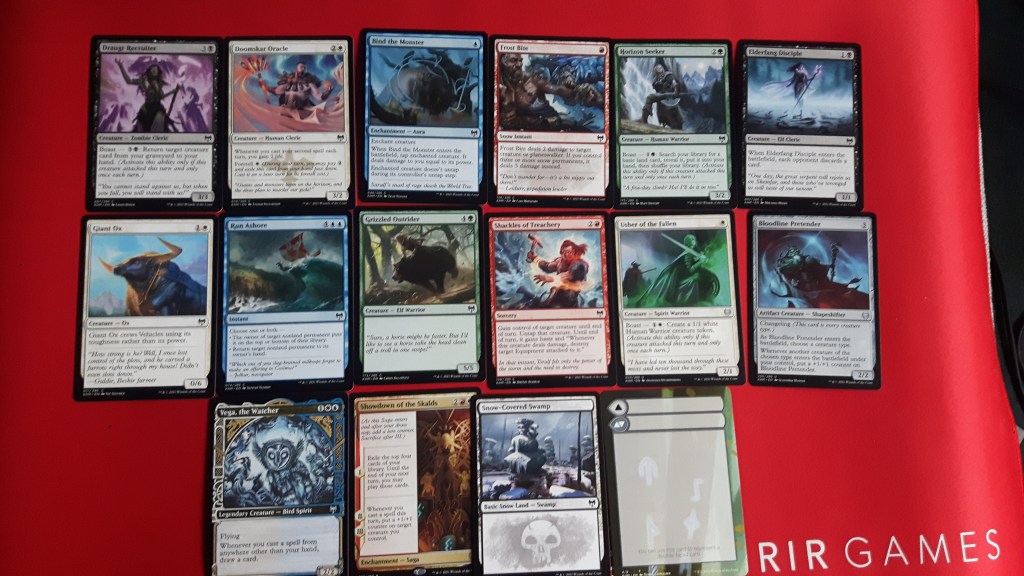
    Prize Pack 2

    End Step

    This was honestly a really fun project to try undertake, though it was slightly rushed due to having a day delay on receiving the prerelease kit, so, apologies for the messy photos (taken on a not great phone) and for some of the analysis probably not being entirely logical.

    This was done as a way to get the prerelease experience I have almost gone a year without now (if any of my MtG friends are reading this, know I miss you greatly right now) at home, and to create a more unique piece of MtG content on my site. It was a bit disappointing to find no mythic rares in both kit and prize packs, though I reckon that foil Snow Covered Island is worth quite a bit to the right person.

  • My Magic: the Gathering Pet Cards (Part 1)


    (NB: Originally uploaded to https://geekoutuk.com/2019/11/08/my-magic-the-gathering-commander-pet-cards/)

    As is evidenced by an article on this very site, and to anyone who is near me for even the shortest amount of time, my favourite way to play Magic: the Gathering is in the Commander format.

    I’ve already talked about it before, but I’ll quickly recap the rules:

    • Legendary Creature(s) or Legendary Planeswalker(s) as your “Commander”
    • 99 card singleton (one copy of each card) deck (You can have duplicate basic lands)
    • 40 life starting life
    • Being dealt 21 points of combat damage by a single commander is an automatic loss
    • Traditionally played multiplayer but is viable in 1v1

    Over the two years I’ve been enjoying Magic both casually and competitively, I was slowly drawn away from the draft and Standard play I’d been participating in and moved into the format I keep brewing decks for today.

    And, as with most players who brew multiple decks, cards start to show up where you don’t include them because they’re the top tier of the format, or a must-include in your chosen colours; you include them because you like them.

    These are often referred to as “pet cards”, cards which tend to be incredibly personal to a player for various reasons. Pet cards can be powerful, generally and in the right scenario, but sometimes they can be a card you appreciate for the art, a card that holds significant emotional value to you, or pure, unfiltered, long shot jank.

    Here are just a few of the cards I consider my pet cards:

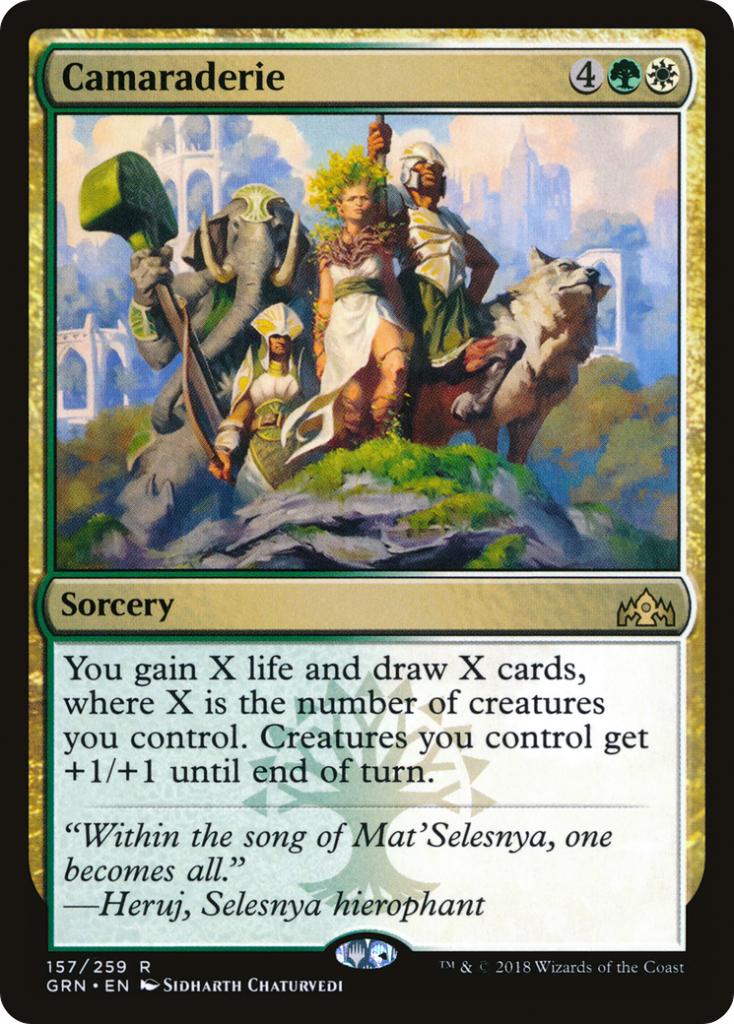
    Camaraderie

    From the start, Camaraderie has a steep hill to climb. Requiring 6 mana total to cast and two of it being different colours, the card should have a potent effect that goes a way to affect the board state in an impactful way.

    But it doesn’t, well, not massively so.

    For a start, without creatures on your side of the field; the card is dead in your hand until you develop a board back up meaning it’s not really a card you can play in response to a board wipe. The buff to your creatures is also fairly inconsequential, as a one turn only minor buff isn’t going to do much, unless you have a serious go-wide strategy going on.

    So why do I like it?

    It just feels right to me, for one reason or another. Despite its flaws whenever I’m building a deck which includes Green and White and I start to consider what sort of card draw I’m going to need, my mind usually drifts over towards including Camaraderie before anything else.

    I currently use it in my +1/+1 counter synergy deck and my token generation deck. In the former it fits right in with the greedy strategy I run with; I aim to get a good selection of big creatures on my board which fuels my card draw spells, allowing me to bring things to an end.

    In the latter, it has the potential to be bonkers.

    My token generation deck focuses on creating lots of smaller token creatures to achieve a “death by a thousand cuts” style of victory. But life gain, combined with the nuke that is Aetherflux Reservoir, has had some showings.

    Given 1 or 2 turns of carefully cultivating the correct quantity of tokens; Camraderie goes from “decent draw spell” to “drawing three times the maximum hand size”, which, yes, I do have to discard most of it because I don’t run cards that make me ignore hand size, but that then gives me something that can be just as important as card advantage: card selection. The ability to choose which cards are going to be best suited going forward.

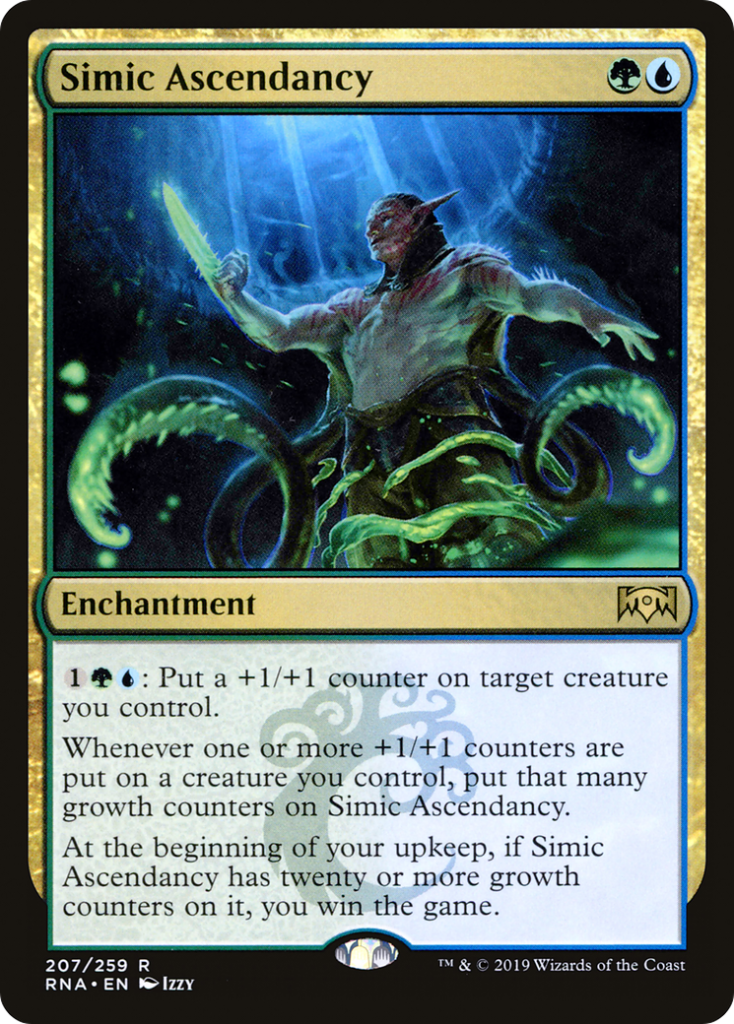
    Simic Ascendancy

    As explained by Joel right here; you don’t necessarily have to deplete your opponent’s life total to gain victory. 25 of these alternate victory cards currently exist in the game and all of them offer a more elaborate route to victory.

    Simic Ascendancy is one of the more straight forward alternate victory cards, simply requiring for 20 +1/+1 counters to be placed on your creatures and to reach your next upkeep step. This counter can be accelerated through the mechanic Proliferate, which not only lets you add extra counters onto creatures; it also lets you add counters directly onto Ascendancy itself.

    Ascendancy is one of the few alternate victory cards that are able to fuel its own win condition. Many of them are static effects that will trigger when the condition is met, but the activated ability on the card allows for self-sufficient victory provided you have creatures.
    The major downside to Ascendancy (and other such cards)? No in-built protection. Without an ability such as Shroud or Hexproof to prevent removal spells from targeting it; Ascendancy is often left in a vulnerable position where turns worth of hard work can be undone within the constraints of a single phase.

    However, this downside has not stopped me from including it in every list which contains Blue and Green. Part of this is due to me owning a full playset (4 copies) of a promotional foil version of the card which adds a bit of flair to my decks, but also because of how easily it can slot into a deck.

    Even in decks where the main focus is drawn away from +1/+1 counters or proliferation it can become a silent threat on the table, slowly ticking over as turns go by until finally, when it becomes noticed by the rest of the table; it’s far too late.

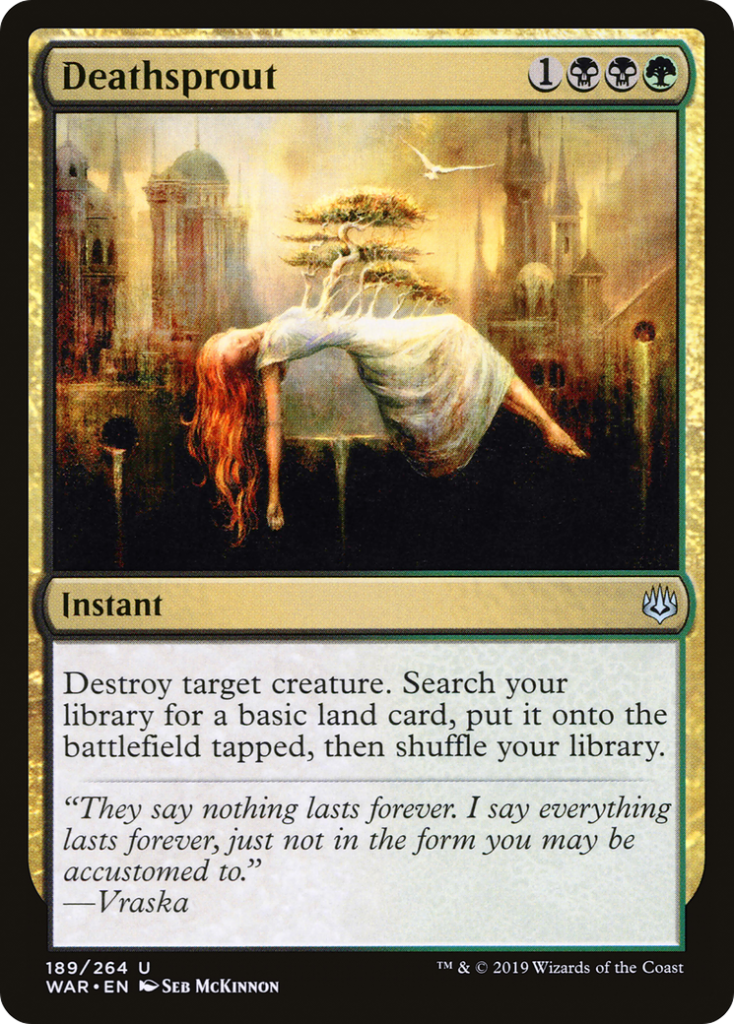
    Deathsprout

    For a start, that goddamn art. Seb McKinnon consistently creates gorgeous pieces for Magic and this is no exception.

    Green and Black is a colour pair in Magic that is considered an “enemy” pair, in that the philosophies they represent are opposite. Green is the colour of life and its continuance, black is the colour of death and its inevitable nature. Whilst these are opposing views, together they form the belief that life ends in one form but can be reborn in another.

    This fact is referenced in the flavour text, attributed to Vraska, a prominent figure within the Golgari Swarm on Ravnica, a guild populated heavily by necromancers and one that subscribes heavily to the idea that both life and death are one large cycle.

    Flavour reasons aside, why I love this card? Utility.

    Comparing it to an existing card at a slightly lower mana cost, Murder, shows what Deathsprout adds to it. Both are instant-speed, single-target removal spells, but for one extra green mana you can fetch a basic land from your deck. Adding in what it would cost for fetching a basic at instant speed (Natural Connection), we can see that Deathsprout, in one card and for 4 total mana, gives us what otherwise would take two cards and a total of 6 mana. It’s rather efficient and I love it for that.

    End Step

    These are just a few of the cards which I always feel like slipping in whenever I build a Commander deck. Of course, I always have more to share, and perhaps I will one day. Have you got any cards that are must-includes in the decks you build? Are you the type of person who can’t go without a certain counter-spell? Let me know in the comments.

  • Star Realms Frontiers

    (NB: Originally posted to https://geekoutuk.com/2018/09/28/star-realms-frontiers/)

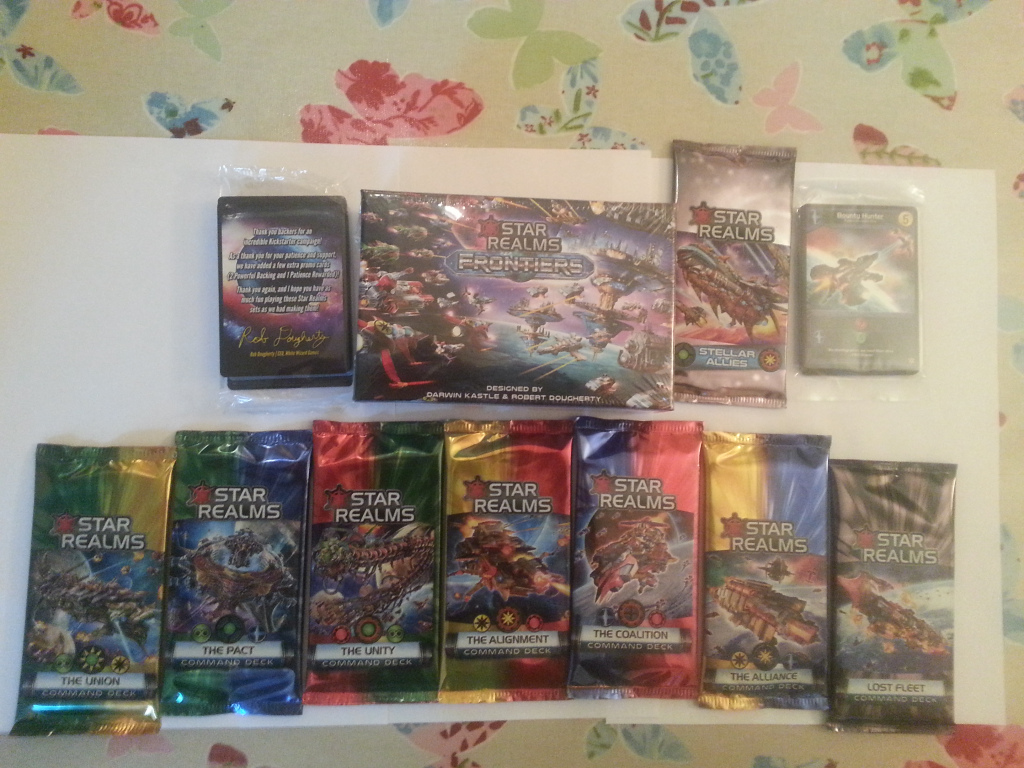
    Back in August 2017, I backed this product on Kickstarter as an early birthday present, under the impression it would’ve come in time for December that same year. A handful of delays with design and printing eventually led the EU fulfilment to happen this September.

    Was it worth the wait?

    Quick recap

    I’ve reviewed the original Star Realms on GeekOut before, so have a read here for the game’s mechanics in depth.

    In short, you get a starting deck of not-great cards, you use those not-great cards to buy new cards for your deck, with the goal of eventually cycling out the not-great cards so all you draw is straight gas.

    The game itself

    Since the basics of the game have been covered in the past, I’ll use this space to talk about how the cards in this box compare to the previous two sets.

    A new mechanic has been introduced in the form of “Double Ally Abilities”. Previously, faction synergy only required another card of the same colour to activate, however in a self-explanatory way, these new abilities require two other cards of the same colour.

    The game now natively supports 4 players, with a respective number of starter decks included. One major change is how a player’s Authority (life) can be tracked out of the box, a massive improvement at that.

    Previously the box would include double sided cards with 20/10 or 5/1 printed on them. I never touched these cards due to how clunky this system is; dice/phone counters being a preferable option. Now life tracking is done using two cards, one with digits, one with multiples of 10. These cards have been designed in a way that a multiple of 10 can be aligned next to a digit to represent a player’s total.

    The system is similar to using a D100 and D10 together

    The basic composition of the trade deck included is the same. 80 total cards (20 of each faction) with multiple copies of the smaller, cheaper ships and singleton copies of the more powerful, more expensive ships. Each of the factions retain their preferred playstyle from previous boxes:

    • Trade Federation/Blue focuses on synergy with bases, healing and trade
    • Machine Cult/Red focuses on destroying bases and scrapping cards from your deck
    • Star Empire/Yellow focuses on discarding cards to draw cards and making opponents discard
    • Blob/Green focuses on pure, unfiltered combat potential and card draw

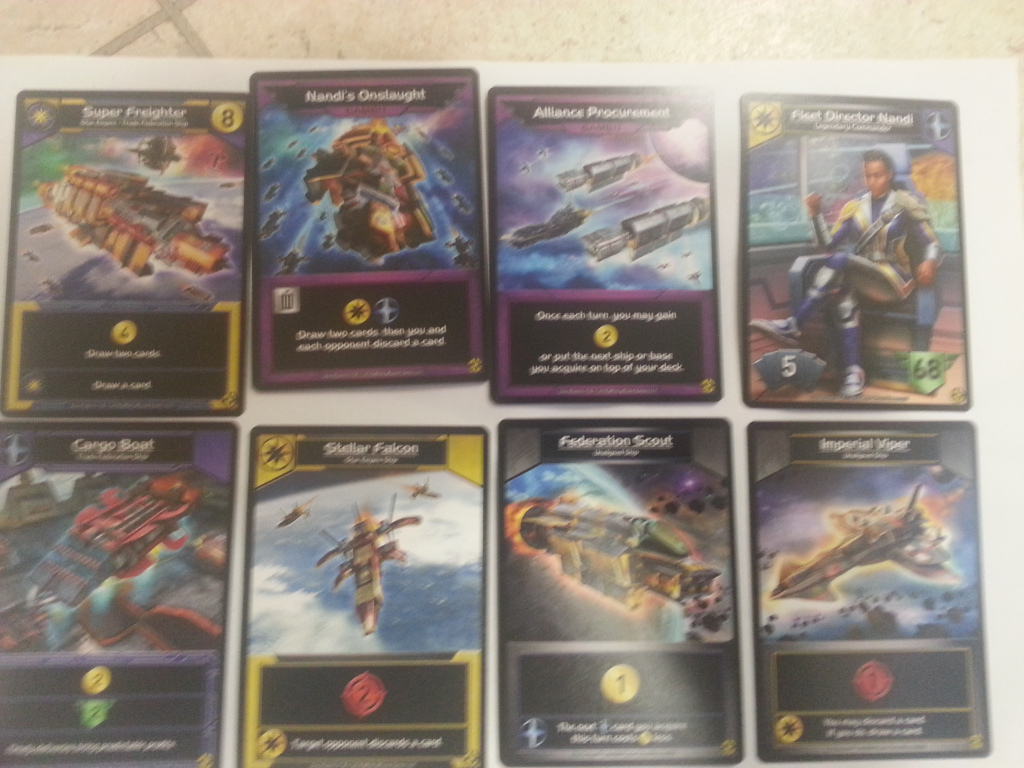
    In terms of art direction, it is not only consistent, it is just as impressive. From the organic monstrosities of the Blob to the militaristic sleekness of the Star Empire; every ship and base conveys the identity of its faction in a way that creates flavour without words.

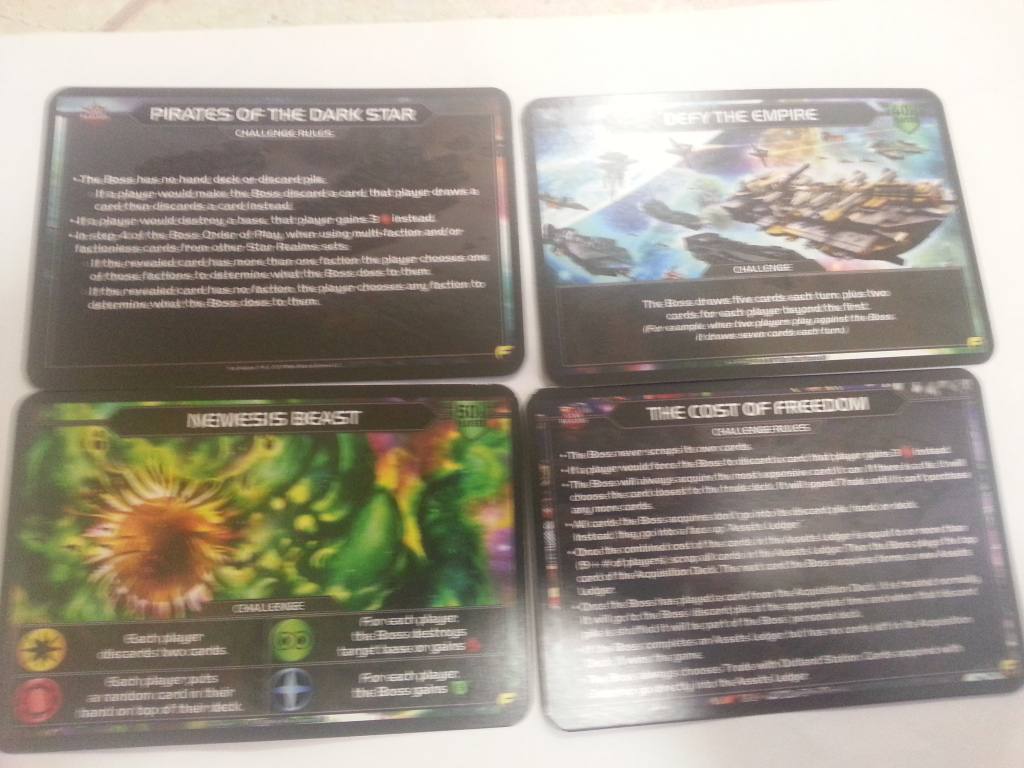
    Finally, the box contains a small selection of “Challenge Cards”, printed on oversized cards. Designed for either solo or co-op play, these cards can be used for a sort of Player VS Environment (PvE) playstyle. Each challenge plays differently from the others, with all the information on the rear of the card and in the rulebook included in the box.

    Kickstarter benefits

    The tier I pledged for Frontiers was one which came with all manner of add-ons:

    • A pack containing the stretch goal promo cards from the Kickstarter campaign
    • A pack containing recent tournament promo cards
    • A “Stellar Allies” pack featuring dual faction cards
    • Some additional expansions which I need for my collection
    • 7 “Command Decks”, one of which is Kickstarter exclusive

    The final bullet point is the one I want to elaborate on, as it is a radically different way of playing Star Realms.

    With Command Decks, you take the role of a prominent commander within a dual faction pair. In taking this role you get certain benefits which vary from deck to deck, the common theme between these benefits being your starting life and hand size for each turn. Each deck also comes with two “Gambits” unique to their commander, life tracking cards which art to reflect the theme of the deck and an 8-cost ship to add to your personal collection.

    One of the best ways to utilise a Command Deck is to play a game mode called “Raid”, which is a 1-VS-Many format. This game mode involves a player assuming the role of the Raid Boss, who uses a Command Deck to give themselves a boost. That said, playing with these decks in simple 1v1 play can diversify the experience along with ramping up the speed of play.

    Conclusion

    In answer to my earlier question “Was it worth the wait?”.

    Yes.

    Yes, it was.

    It’s hard for me to say what Star Realms means to me at this point, this is a card game I have collected almost every card from (save a few promos from supplemental products). It’s a card game that I always try to carry in my bag due to how easy it is to set up and play.

    Rob, Darwin, thank you. The extra time taken for this to get into the hands of backers has led to a fantastically well-rounded addition to an already brilliant game. I know it will be a while before new Star Realms content comes into circulation, but this little box is more than enough to tide me over.

    Now to get 700+ sleeves for this massive collection.

  • Dubious Double-Sided Designs | A Magic: the Gathering Discussion

    (NB: Originally posted to https://geekoutuk.com/2019/07/22/dubious-double-a-magic-the-gathering-discussion/)

    (Foreword: Thanks to Joel for hearing me out on this idea one night and helping develop it. These theoretical card designs were created using mtg.design)

    Ever since their introduction in the original Innistrad block; double-faced cards have remained a very popular mechanic in Magic: the Gathering. To date, we have got:

    The penultimate entry is one for discussion today, because I want to test the idea of a Planeswalker that can become not-a-Planeswalker.

    Thematically, a Planeswalker is an individual who is gifted with a “Planeswalker spark”, an innate ability that allows them to travel between planes. Within the story there have also been instances of Planeswalkers giving up their spark to achieve various goals, so, a Planeswalker card that becomes something else can work in game.

    I’m going to work with an example that happened in the story itself, the ascension of Xenagos to Nyx.

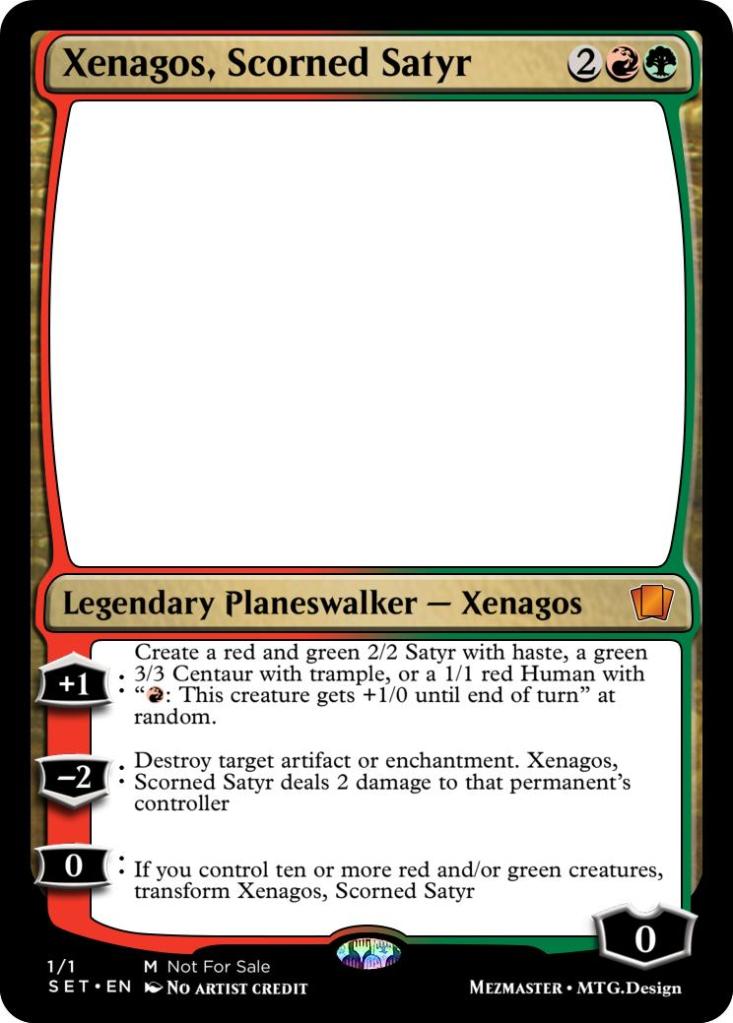
    Xenagos, Scorned Satyr

    Gods in Theros are born and sustained by the belief of their followers. Xenagos ascended in the aftermath of a large celebration (or Revel, to be accurate), and more revellers joined in as time went on. Using this we can have the plus ability on our theoretical Xenagos create token creatures to reflect the Revel growing larger.

    The obvious choice here would Satyrs, but creatures of all forms joined in the Revel, so the potential ability could read as:

    +1: Create a red and green 2/2 Satyr with haste, a green 3/3 Centaur with trample, or a 1/1 red Human with “{R}: This creature gets +1/0 until end of turn” at random.

    As the Revel goes on, Xenagos’ power grows, and he gains more followers. And as more individuals join, the likelihood of something (and/or someone) getting broken is going up. Thankfully, the card “Destructive Revelry” gives us a pretty good idea of what this looks like, Planeswalker abilities have been known to mimic spells before, which gives us a minus ability:

    -2: Destroy target artifact or enchantment. Xenagos, Scorned Reveler deals 2 damage to that permanent’s controller.

    Finally, we need to have a way of transforming Xenagos. His ascension happened when the Revel reached a critical mass of followers, so we need to be able to represent this in an ability which should also interact with the plus ability.

    0: If you control ten or more red and/or green creatures, transform Xenagos, Scorned Satyr

    With all abilities lined up, we can now figure out what the mana cost and starting loyalty should be, though personally I feel keeping to original Xenagos’ layout of 2 generic mana, a red mana and a green mana with a starting loyalty of 3 works pretty well. The flip ability doesn’t require loyalty counters so they are purely there for survivability and using the minus ability every so often.

    (Present Rosalia notes: I like how I unintentionally designed “Outlaws’ Merriment” before it was officially revealed for Eldraine. I know sets are often designed years in advance, it’s just kind of funny to me)

    Xenagos, Usurper of Nyx

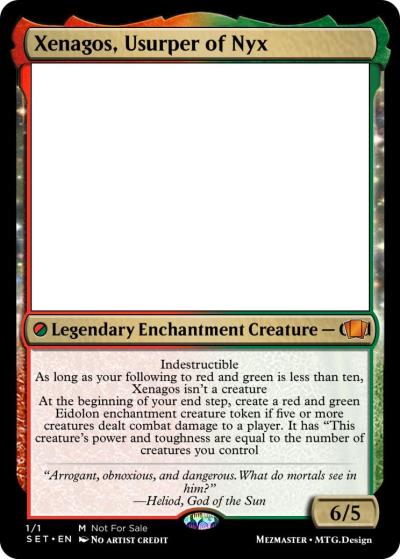
    Having now taken his place amongst the pantheon; Xenagos has gone from Planeswalker to a more fitting “Legendary Enchantment Creature – God”.

    As is expected, his first line of text is “Indestructible”. All Gods in Magic have some way of sticking around or surviving removal effects, and the most straight forward one works here.

    With already existing Theros gods, they use a mechanic called “Devotion” (the amount of colour mana symbols on cards totalled together) to determine whether a God counts as a creature. However, the previous side of Xenagos has been pumping out creature tokens, which have no coloured mana symbols on them meaning no progress towards devotion.

    To maintain the flavour of Gods needing a pre-condition to counting as a creature and making it so the mechanics of the previous side interact, a new mechanic can be proposed:

    Following: Your Following count is equal to the number of creatures in the specified colours”

    So, the second line of text on our new Xenagos can read:

    “As long as your Following to red and green is less than ten, Xenagos isn’t a creature”

    This allows Xenagos to act as a creature from the get-go, as he had already gathered a required Following in order to ascend. Now he needs to have an ability that interacts with the heavily populated board state, and manifests the ideal of the Great Revel.

    With bonus hypocritical Heliod flavour text

    “At the beginning of your end step, create a red and green Eidolon enchantment creature token if five or more creatures dealt combat damage to a player. It has “This creature’s power and toughness are equal to the number of creatures you control.”

    An ability like this gives an ever-increasing payoff to a go-wide strategy, which reflects the rituals that Xenagos performed during his ascension, bringing Nyxborn entities into the mortal realm.

    And, as with Scorned Satyr, I’m keeping this Xenagos in line with his existing counterpart by making his power and toughness 6/5.

    So, that’s my proposal for a Planeswalker that has the potential to flip into something else. It’s most definitely unbalanced and requires refinement, but as a dubious design, it fits the title quite nicely. Please feel free to give any feedback, both mechanically and flavour-wise on how the cards turned out.